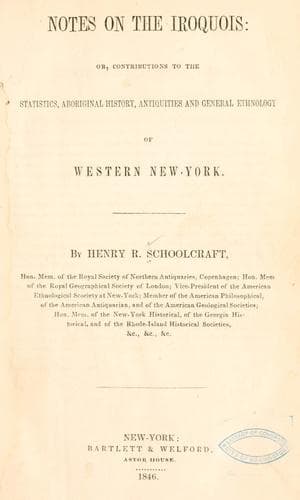
Notes on the Iroquois: or, Contributions to the Statistics, Aboriginal History, Antiquities and General Ethnology of Western New-YorkSchoolcraft, Henry Rowe
History
Notes on the Iroquois: or, Contributions to the Statistics, Aboriginal History, Antiquities and General Ethnology of Western New-York
Schoolcraft, Henry Rowe
Indians of North America -- New York (State); Iroquois Indians
Terenyawagon, the Holder of the Heavens, who was the patron of the
home bands, did not fail, in this crisis, to direct their way also.
After giving them practical instructions in war and hunting, he guided
their footsteps in their journies, south and east, until they had
crossed the Alleghanies, and reached the shores of the sea, on the
coasts which are now called the Carolinas. They were directed to fix
their residence on the banks of the Cau-tan-o, that is, a Pine in the
water, now called Neuse river, in North Carolina. By this time their
language was altered, but not so much but that they could understand
each other. Here Terenyawagon left them to hunt, increase and prosper,
whilst he returned to direct the remaining Five Nations to form their
confederacy. Thus far the Tuscarora annalist. History picks up the
Tuscaroras precisely where tradition and fable leave them. On the
settlement of Virginia and the Carolinas, they were found to be the
first nation of any stability of purpose, after passing the Powhatanic
tribes, in proceeding south. The intervening coast tribes were petty
chieftaindoms, few in numbers and disunited in action or policy. They
were essentially ichthyophagi. They soon fell before the two-fold
influence of idleness and rum, and have left little or no history, or
traits worth preserving. Such is the history of the Chowanokes,[39]
the Maratocks, and the Mangoacks, who, in one hundred and twenty years
from the date of Raleigh’s patent, had dwindled from 6,000 to forty-six
bowmen.[40]
[39] Mr. Jefferson thinks (vide Notes, p. 152, London ed. of 1787,)
that this tribe was connected with the Tutelos, Nottaways and Meherrins
of Virginia.
[40] Williamson.
The Tuscaroras, who lived in the game country, on the skirts of the
mountains, showed themselves at the mouths of Cantano or Neuse,
Contentny, and Taw rivers. They were, at the time, numerous and
warlike, and as inimical to the inhabitants of the Carolinas, as they
were numerous. They were at war with the Catabas, the Cowetas and the
Cherokees. Numbers, bravery and success, and abundance of animal food,
made them haughty, and they evinced the disposition of their northern
brethren, by trying to subjugate and break down their neighbors. What
they had done with red men, very effectually, it must be confessed at
least with the Catabas, they thought they might do with the Hugenots of
France, the cavaliers of England, and the protestants of the baronetcy
of Graffenried in Germany. It is not improbable, indeed, that, at a
prior era, the Tuscaroras were the very people who had exterminated
the colony left on Roanoke island, under the first attempts of Sir
Walter Raleigh to colonize Virginia. But, if such were the fact—a mere
conjecture at best—they mistook their present neighbors and their own
position in attempting to repeat the act.
Public-domain text, read in full here on John Shaqi.
Reviews
Reviews
No reviews yet
Be the first to share your thoughts on this work.
Join the Discussion
Join the discussion
Sign in to leave a comment or review.
Sign InorCreate an account