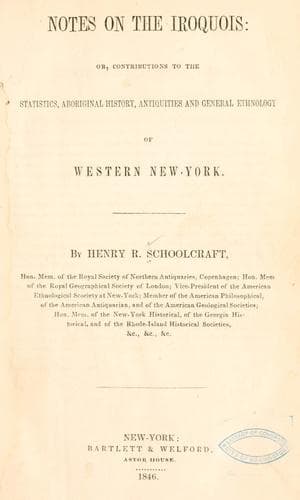
Notes on the Iroquois: or, Contributions to the Statistics, Aboriginal History, Antiquities and General Ethnology of Western New-YorkSchoolcraft, Henry Rowe
History
Notes on the Iroquois: or, Contributions to the Statistics, Aboriginal History, Antiquities and General Ethnology of Western New-York
Schoolcraft, Henry Rowe
Indians of North America -- New York (State); Iroquois Indians
This scheme was, however, deeply laid, although it appeared to be a
matter hastily executed. They had long felt a growing jealousy of
the encroaching settlements, and gave vent to it, the first occasion
that offered, by seizing Lawson the surveyor-general of the Province,
on a trip up the Neuse, and after a kind of trial before a council,
putting him to death. The Baron Graffenried, who was with him, and
was also condemned, but saved, on an appeal on the ground of his being
a man of rank and not an Englishman; but they kept him a prisoner,
while they proceeded to execute their ill-advised and nefarious plot,
which was nothing less than the massacre of the entire colony in one
day. The day fixed for this tragedy was the 22d of September, 1711.
Williamson[41] thinks it was an impulsive movement arising from the
killing of Lawson, who being a public officer, they felt themselves
committed in a war, and resolved to proceed with the bloody work.
For this purpose they divided themselves into small bands of six or
seven, and entering the settlements at various points, they struck
down with the tomahawk on one day one hundred and thirty persons. To
conceal their intentions, they had left their arms, and relied on their
hatchets alone. In this plot, they were assisted by the sea-coast
bands of Corees, Mattamuskeets and Bear-river Indians, some three or
four tribes, denoting a league and maturity in the attempt. But the
plan did not succeed to their wishes, for besides that the colony
consisted then of nearly two thousand men, much spread, it must needs
have happened that many at the time of attack, would be absent from
their homes. The colonists rallied, and prepared to carry the war home
to their subtle assailants. They asked the aid of South Carolina,
which came gallantly to their rescue. The Legislature of that Province
having granted four thousand pounds, placed Col. Barnwell at the head
of a small detachment of armed men, supported by a large body of
Cherokees, Creeks and Catabas, the deadly enemies of the Tuscaroras.
He killed, in various actions, thirty Tuscaroras, and fifty of the
sea-coast auxiliaries, and took two hundred women and children of the
latter prisoners, and returned. The war thus commenced was continued,
with various results for some few years. The aid of Virginia, as well
as South Carolina was invoked the next year. The Tuscaroras also made
vigorous exertions. They were well provided with arms and ammunition,
and despatched runners to the Senecas for aid. Their auxiliaries, the
Mattamuskeets, Corees and others killed or made prisoners the next
winter, forty inhabitants of the Island of Roanoke or Croatan. The
Tuscaroras prepared to maintain their power by entrenching themselves
behind a picketed work on the river Taw. This work, called fort
NAHARUKE, stood on a plain beside a creek, and consisted of
a rampart of earth, covering the whole ground occupied, defended with
palisades.
Public-domain text, read in full here on John Shaqi.
Reviews
Reviews
No reviews yet
Be the first to share your thoughts on this work.
Elsewhere in the archive
Join the Discussion
Join the discussion
Sign in to leave a comment or review.
Sign InorCreate an account