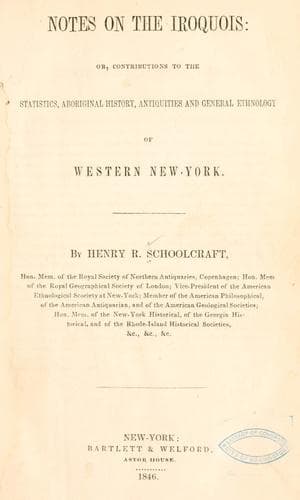
Notes on the Iroquois: or, Contributions to the Statistics, Aboriginal History, Antiquities and General Ethnology of Western New-YorkSchoolcraft, Henry Rowe
History
Notes on the Iroquois: or, Contributions to the Statistics, Aboriginal History, Antiquities and General Ethnology of Western New-York
Schoolcraft, Henry Rowe
Indians of North America -- New York (State); Iroquois Indians
Curious to obtain some clue to this era, or test of the preceding
data, I made it a topic of inquiry. The Onondagas, the Tuscaroras,
and the several bands, unite in a general tradition of the event of
a confederacy, at the head of which they place Atotarho, (the same
doubtless whose name is spelt Tatotarho above,) but amongst neither
of these tribes is the era fixed. The dates employed by Cusick,
the Tuscarora legendary, giving an extravagant antiquity to the
confederation, are more entitled to the sympathy of the poet than the
attention of the historian, although other traditions stated by him
debarring the dates, may be regarded as the actual traditions of his
tribe. Were the dates moderate, which he generally employs to confer
antiquity on his nation, they might inspire respect. But like the
Chinese astronomers, he loses no little as a native archæologist, by
aspiring after too much.
Atotarho, who by these traditions was an Onondaga, is the great
embodiment of Iroquois courage, wisdom and heroism, and in their
narrations he is invested with allegoric traits, which exalt him to
a kind of superhuman character. Unequalled in war and arts, his fame
had spread abroad and exalted the Onondaga nation to the highest
pitch. He was placed at the head of the confederacy, and his name,
like that of King Arthur of the Round Table, or those of the Paladins
of Charlemagne, was used after his death as an exemplar of glory and
honor; while like that of Cæsar, it became perpetuated as the official
title of the presiding chief. What is said by Pyrlaus respecting the
mode of the transmission of the names of the first delegates to the
council forming the confederacy, appears to be probable. It is true,
so far as is known, but it seems that not only the name of the ruling
chief, but the title of each minor officer in the council, as he who
presents the message; he who stands by the chief or Atotarho, &c.
is preserved to this day by its being the name of an individual who
exercises a similar office.
Public-domain text, read in full here on John Shaqi.
Reviews
Reviews
No reviews yet
Be the first to share your thoughts on this work.
Elsewhere in the archive
Join the Discussion
Join the discussion
Sign in to leave a comment or review.
Sign InorCreate an account