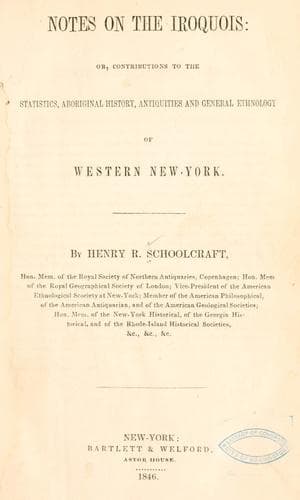
Notes on the Iroquois: or, Contributions to the Statistics, Aboriginal History, Antiquities and General Ethnology of Western New-YorkSchoolcraft, Henry Rowe
History
Notes on the Iroquois: or, Contributions to the Statistics, Aboriginal History, Antiquities and General Ethnology of Western New-York
Schoolcraft, Henry Rowe
Indians of North America -- New York (State); Iroquois Indians
When the 54° parallel came to be drawn, under the provision of the
treaty of Ghent, it cut the St. Regis settlement unequally in two,
leaving the church and the larger portion of the Indian population
within the bounds of Canada. Those who reside within the limits of
New-York, numbered, the past summer, three hundred and sixty souls.
III. EPOCH AND PRINCIPLES OF THE IROQUOIS LEAGUE.
[_a._] Considerations.
Something on this head appears desirable, if it be only to mitigate,
in some degree, our historical ignorance, and want of accurate or
precise information, touching it. The question of the principles of
their social and political association, is one of equal interest and
obscurity, and would justify a more extended inquiry than is here given.
[_b._] Era of the Confederation.
Chronology finds its most difficult tasks in establishing dates among
our aboriginal tribes. Pyrlaus, a missionary at the ancient site of
Dionderoga or Fort Hunter, writing between 1742 and 1748, states, as
the result of the best conjectures he could form, from information
derived from the Mohawks, that the alliance took place “one age, or
the length of a man’s life, before the white people came into the
country.”[44] He gives the following as the names of the sachems of the
Five Nations, who met and formed the alliance:
[44] Trans. Hist. and Lit. Com. Am. Philo. Soc. vol. 1, p. 36.
TOGANAWITA, _for the Mohawks_.
OTATSCHECHTA, _for the Oneidas_.
TATOTARHO, _for the Onondagas_.
TOGAHAYON, _for the Cayugas_.
GANIATARIO, }_for the Senecas_.
SATAGARUYES,}
The name of THANNAWAGE is given as the first proposer of such
an alliance. He was an aged Mohawk sachem. It was decided that these
names should forever be kept in remembrance by naming a person in each
nation, through succeeding generations, after them.
Taking 1609, the era of the Dutch discovery, and estimating “a man’s
life” by the patriarchal and scriptural rule, we should not at the
utmost have a more remote date than 1539,[45] as the origin of the
confederacy. This would place the event 18 years after the taking of
Mexico by Cortes, and 47 years after the first voyage of Columbus.
Cartier, who ascended the St. Lawrence to Hochelaga, the present site
of Montreal, in 1535, demonstrates clearly, by his vocabulary of words,
that a people who spoke a branch of the Iroquois language, was then at
the place. This people is usually supposed to have been the Wyandots,
or Hurons. But he makes no remark on a confederacy. He only denotes the
attachment of the people to an old and paralytic sachem, or head chief,
who wore a frontlet of dyed porcupine’s skin.[46]
[45] For other data on this topic, see the subsequent paper, entitled
“Onondagas,” in which an earlier date is assigned. See also the article
“Oral Traditions.”
[46] Oneota, p. 172.
Public-domain text, read in full here on John Shaqi.
Reviews
Reviews
No reviews yet
Be the first to share your thoughts on this work.
Elsewhere in the archive
Join the Discussion
Join the discussion
Sign in to leave a comment or review.
Sign InorCreate an account