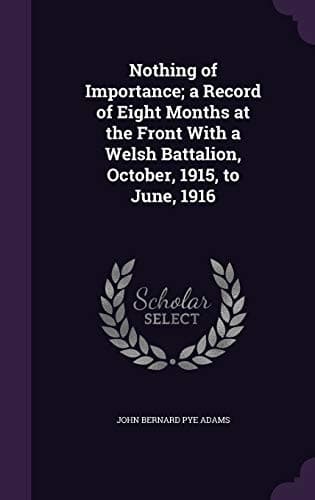
Nothing of Importance: A record of eight months at the front with a Welsh battalion, October, 1915, to June, 1916Adams, Bernard
History
Nothing of Importance: A record of eight months at the front with a Welsh battalion, October, 1915, to June, 1916
Adams, Bernard
World War, 1914-1918 -- Personal narratives, English
As I opened the door of my billet, I heard a “strafe” getting up. There
was a lively cannonade up in the line; for several minutes I listened,
until it diminished a little, and began to die away. “In” to-morrow,
I thought. My valise was laid out on the floor, and my trench kit all
ready for packing first thing next morning. I lost no time in getting
into bed. And yet I could not sleep.
I could not help thinking of the jollity of the last few hours, the
humour, the apparently spontaneous outburst of good spirits; and most
of all I thought of old Jim, the mainspring somehow of it all. And
again I saw the picture of the concert a few nights ago, the bright
lights of the stage, the crowds of our fellows, all their bodies and
spirits for the moment relaxed, good-natured, happy, as they stood
laughing in the warm night air. And lastly I thought again of Private
Benjamin, that refined eager face, that rather delicate body, and
that warm hand as I placed mine over his, squeezing the trigger. He
was no more than a child really, a simple-minded child of Wales.
Somehow it was more terrible that these young boys should see this
war, than for the older men. Yet were we not all children wondering,
wondering, wondering?... Yes, we were like children faced by a wild
beast. “Sometimes I dislike you almost,” I thought; “your dulness, your
coarseness, your lack of romance, your unattractiveness. Yet that is
only physical. You, I love really. Oh, the dear, dear world!”
And in the darkness I buried my face in the pillow, and sobbed.
CHAPTER XV
“A CERTAIN MAN DREW A BOW AT A VENTURE”
It was ten o’clock as I came in from the wiring-party in front of Rue
Albert, and at that moment our guns began. We were in Maple Redoubt.
The moon had just set, and it was a still summer night in early June.
“Come and have a look,” I called to Owen, who had just entered the
dug-out. I could see him standing with his back to the candlelight
reading a letter or something.
He came out, and together we looked across the valley at the shoulder
of down that was silhouetted by the continuous light of gun-flickers.
Our guns had commenced a two hours’ bombardment.
“No answer from the Boche yet,” I said.
“They’re firing on C 2, down by the cemetery.”
“Yes, I hardly noticed it; our guns make such a row. By Jove, it’s
magnificent.”
We gazed fascinated for a long time, and then went into the dug-out
where Edwards and Paul were snoring rhythmically. I read for half an
hour, but the dug-out was stuffy, and the smell of sand-bags and the
flickering of the candle annoyed me for some reason or other. Somehow
“Derelicts” by W. J. Locke failed to grip my attention. Owing to our
bombardment, there were no working-parties, in case the Germans should
take it into their head to retaliate vigorously. But at present there
was no sign of that.
Public-domain text, read in full here on John Shaqi.
Reviews
Reviews
No reviews yet
Be the first to share your thoughts on this work.
Elsewhere in the archive
Join the Discussion
Join the discussion
Sign in to leave a comment or review.
Sign InorCreate an account