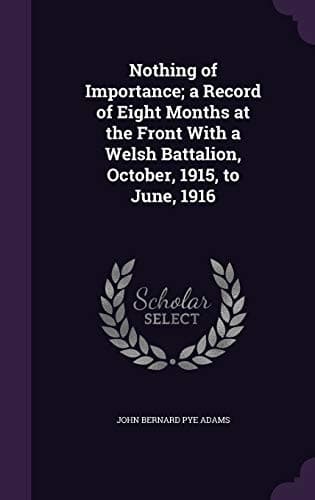
Nothing of Importance: A record of eight months at the front with a Welsh battalion, October, 1915, to June, 1916Adams, Bernard
History
Nothing of Importance: A record of eight months at the front with a Welsh battalion, October, 1915, to June, 1916
Adams, Bernard
World War, 1914-1918 -- Personal narratives, English
I went back and visited the other gun position, and spent a few minutes
there also. At last I turned in reluctantly. I went out again at
half-past eleven, and still the shells were screaming over. It seemed
the token of an irresistible power. And there was no reply at all now
from the German lines.
* * * * *
The short summer nights made life easier in some respects. We “stood
to” earlier, and it was quite light by three. As I turned in again,
I paused for a moment to take in the scene. Davies had retired to a
small dug-out, that looked exactly like a dog-kennel, and was not much
larger. As Davies himself frequently reminded me of a very intelligent
sheepdog, the dog-kennel seemed most suitable. I heard him turning
about inside, as I stood at the door of our own dug-out.
The scene was one of the most perfect peace. The sun was not up, but
by now the light was firm and strong; night had melted away. I went
back and walked a little way along Park Lane until I came to a gap in
the newly erected sand-bag parados. I went through the gap and into a
little graveyard that had not been used now for several months. And
there I stood in the open, completely hidden from the enemy, on the
reverse slope of the hill. Below me were the dug-outs of 71 North,
and away to the left those of the Citadel. Already I could see smoke
curling up from the cookers. There was a faint mist still hanging about
over the road there, that the strong light would soon dispel. On the
hill-side opposite lay the familiar tracery of Redoubt A, and the white
zigzag mark of Maidstone Avenue climbing up well to the left of it,
until it disappeared over the ridge. Close to my feet the meadow was
full of buttercups and blue veronica, with occasional daisies starring
the grass. And below, above, everywhere, it seemed, was the tremulous
song of countless larks, rising, growing, swelling, till the air seemed
full to breaking-point.
And there was not a sound of war. Who could desecrate such a perfect
June morning? I felt a mad impulse to run up and across into No Man’s
Land and cry out that such a day was made for lovers; that we were all
enmeshed in a mad nightmare, that needed but a bold man’s laugh to free
us from its clutches! Surely this most exquisite morning could not be
the birth of another day of pain? Yet I felt how vain and hopeless
was the longing, as I turned at last and saw the first slant rays of
sunlight touch the white sand-bags into life.
* * * * *
“What time’s this working-party?” asked Paul at four o’clock that
afternoon.
“I told the sergeant-major to get the men out as soon as they’d
finished tea,” I replied. “About a quarter to five they ought to be
ready. He will let you know all right.”
“Hullo!” said Paul.
“What are you ‘hulloing’ about?” I asked.
Public-domain text, read in full here on John Shaqi.
Reviews
Reviews
No reviews yet
Be the first to share your thoughts on this work.
Elsewhere in the archive
Join the Discussion
Join the discussion
Sign in to leave a comment or review.
Sign InorCreate an account