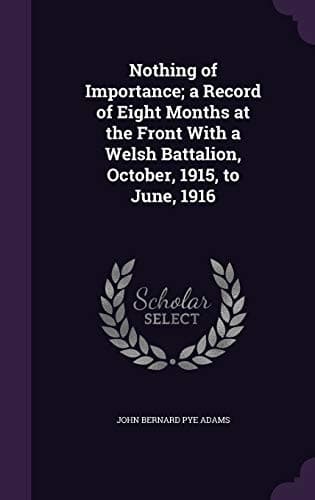
Nothing of Importance: A record of eight months at the front with a Welsh battalion, October, 1915, to June, 1916Adams, Bernard
History
Nothing of Importance: A record of eight months at the front with a Welsh battalion, October, 1915, to June, 1916
Adams, Bernard
World War, 1914-1918 -- Personal narratives, English
“He’s past our help,” said the other man.
At last, after a minute’s calm, we stepped out into the sunshine. I
went round the traverse, following the two stretcher-bearers. And
looking between them, as they stood gazing, this is what I saw.
In the trench, half buried in rags of sand-bag and loose chalk, lay
what had been a man. His head was nearest to me, and at that I gazed
fascinated; for the shell had cut it clean in half, and the face lay
like a mask, its features unmarred at all, a full foot away from the
rest of the head. The flesh was grey, that was all; the open eyes, the
nose, the mouth were not even twisted awry. It was like the fragment of
a sculpture. All the rest of the body was a mangled mass of flesh and
khaki.
“Who is it?” whispered a stretcher-bearer, bending his head down to
look sideways at that mask.
“Find his identity-disc,” said the other.
“It is Lance-Corporal Allan,” said I.
Then up came the regimental sergeant-major, and Owen followed him. They
too gazed in horror for a moment. The sergeant-major was the first to
recover.
“Hi! you fellows,” he called to two men. “Get a waterproof sheet.”
“Come away, old man,” said I to Owen.
* * * * *
In silence we walked back to the dug-out. But my brain was whirling. “A
certain man drew a bow at a venture,” I thought again. That was how it
was possible. No man could keep on killing, if he could see the men he
killed. Who had fired that howitzer shell? A German gunner somewhere
right away in Mametz Wood probably. He would never see his handiwork,
never know what he had done to-day. He would never _see_; that was
the point. Had he known, he would have rejoiced that there was one
Englishman less in the world. It was not his fault. We were just the
same. What of last night’s bombardment? (The memory of Lance-Corporal
Allan up by his gun-position gave me a quick sharp pang.) Had we not
watched with glittering eyes the magnificent shooting of our own
gunners? This afternoon’s strafe was but a puny retaliation.
Slowly it came back to me, the half-formed picture that had arisen in
my mind the night of Davidson’s death. “A certain man drew a bow at a
venture,” expressed it perfectly. It was splendid twanging the bow,
feeling the fingers grip the polished wood, watching the bow-string
stretch and strain, and then letting the arrow fly. That was the
fascinating, the deadly fascinating side of war. That was what made it
possible to “carry on.” I remembered my joy in calling up the artillery
in revenge for Thompson’s death. And then again, whenever we put a mine
up, how exhilarating was the spectacle! Throwing a bomb, firing a Lewis
gun, all these things were pleasant. It was like the joy of throwing
stones over a barn and hearing them splash into a pond; like driving a
cricket ball out of the field.
Public-domain text, read in full here on John Shaqi.
Reviews
Reviews
No reviews yet
Be the first to share your thoughts on this work.
Elsewhere in the archive
Join the Discussion
Join the discussion
Sign in to leave a comment or review.
Sign InorCreate an account