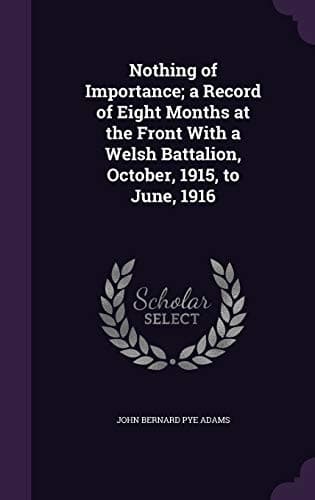
Nothing of Importance: A record of eight months at the front with a Welsh battalion, October, 1915, to June, 1916Adams, Bernard
History
Nothing of Importance: A record of eight months at the front with a Welsh battalion, October, 1915, to June, 1916
Adams, Bernard
World War, 1914-1918 -- Personal narratives, English
It smarted as he undid the bandage. I don’t know what he did. I never
looked at it.
“What sort of a one is it?” I asked.
“I could just do with one like this myself,” said the doctor.
“Is it a Blighty one?”
“I’d give you a fiver for it any minute,” answered the doctor. “I’m
not certain whether the bone’s broken or not, but I rather think it is
touched. I can’t say, though. A bullet, did you say? Are you sure?”
“Very sure,” I laughed.
“Well, it must be one of these explosive bullets, an ordinary bullet
doesn’t make a wound like yours. That’s it. That’ll do.”
“I can’t make out why there’s not more pain,” said I.
“Oh, that’ll come later. You see the shock paralyses you at first.
Here, take one of these.” And he gave me a morphia tabloid.
“Cheero, Bill,” he said, and I went out of the dug-out leaning on a
stretcher-bearer. Round my neck hung a label, the first of a long
series. “Gun-shot wound in left forearm” it contained. I found later “?
fracture. 1.15 a.m., 7.6.16.”
Outside Lewis was waiting with my trench kit. He had appeared a quarter
of an hour back at the door of the dressing-station, and had been told
by the doctor so rapidly and forcibly that he ought to know that he
would go with me to the clearing station, and that he had five minutes
in which to get my kit together, that he had fairly sprinted away.
Poor fellow! How should he know, seeing that he had been my servant
over six months, and I had never got wounded before? But the doctor
always made men double.
As I passed our dug-out, Edwards, Owen, Paul, and Nicholson were all
standing outside.
“Cheero,” I shouted. “Good luck. The doctor says it’s nothing much.
I’ll be back soon.”
“What about that Lewis-gun position?” asked Edwards.
“Oh,” I said, “I want to keep that position on the left.” Then I felt
my decision waver. “Still, if Wetherell wants the other ... I don’t
know.”
“All right. I’ll fix up with Wetherell. Good luck. Hope you get to
Blighty.”
I wanted to say such a lot. I wanted to say that I was sure to be back
in a week or so. I wanted to think hard, and decide about that Lewis
gun. I wanted to send a message to Wetherell apologising for what I
had said.... I wanted to talk to Sergeant Andrews, who was standing
there too. But the stretcher-bearer was walking on, and I must go as he
pleased.
“Good-bye, Sergeant Andrews,” I shouted.
Last of all I saw Davies, standing solemn and dumb.
“Good-bye, Davies. Off to Blighty.”
I could not see if he answered. The relentless stretcher-bearer led me
on. Was I O.C. stretcher-bearers or was I not? Why didn’t I stop him?
I had not decided about that Lewis gun. At the corner of Old Kent Road,
I was told I might as well sit on the ration trolley and go down on
that. And in the full light of dawn, about half-past two, I was rolled
serenely down the hill to the Citadel.
Public-domain text, read in full here on John Shaqi.
Reviews
Reviews
No reviews yet
Be the first to share your thoughts on this work.
Elsewhere in the archive
Join the Discussion
Join the discussion
Sign in to leave a comment or review.
Sign InorCreate an account