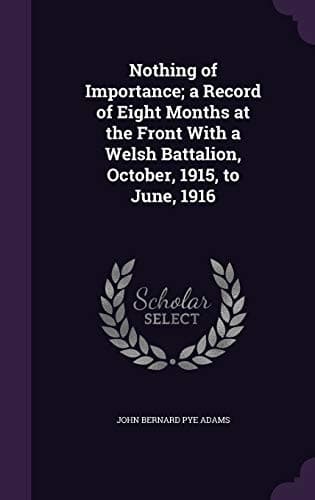
Nothing of Importance: A record of eight months at the front with a Welsh battalion, October, 1915, to June, 1916Adams, Bernard
History
Nothing of Importance: A record of eight months at the front with a Welsh battalion, October, 1915, to June, 1916
Adams, Bernard
World War, 1914-1918 -- Personal narratives, English
I picked up the paper that had fallen at my side. There had been more
terrible fighting on the Somme, and it had seemed very marvellous to a
journalist as he lay on a hill some two miles back, and watched through
his field-glasses: it was wonderful that the men advancing (if indeed
he could really see them at all in the smoke of a heavy artillery
barrage) still went on, although their comrades dropped all round them.
Yet I wondered what else anyone could do but go on? Run back, with just
as much likelihood of being shot in doing so? Or, even if he did get
back, to certain death as a deserter? Everyone knows the safest place
is in a trench; and it is a trench you are making for. Lower down on
the page came a description of the wounded; he had talked to so many of
them, and they were all smiling, all so cheerful; smoking cigarettes
and laughing. They shook their fists, and shouted that the only thing
they wanted to do was to get back into it! Pah! I threw the paper down
in disgust. Surely no one wants to read such stuff, I thought. Of
course the men who were not silent, in a dull stupefied agony, were
smiling: what need to say that a man with a slight wound was laughing
at his luck, just as I had smiled that early morning when the trolley
took me down from Maple Redoubt? And who does not volunteer for an
unpleasant task, when he knows he cannot possibly get it? Want to get
back into it, indeed! Ask Tommy ten years hence whether he wants to be
back in the middle of it again!
I wondered why people endured such cheap journalism. What right had
men who have never seen war at all, who creep up on bicycles to get a
glimpse of it through telescopes, who pester wounded men, and then out
of their pictorial imagination work up a vivid description--what right
have they to insult heroes by saying that “their wonderful spirit makes
up for it all,” that “the paramount impression is one of glory”? Are
not our people able to bear the truth, that war is utterly hellish,
that we do _not_ enjoy it, that we hate it, hate it, hate it all? And
then it struck me how ignorant people still were; how uncertainly they
spoke, these people at home: it was as though they dared not think
things out, lest what they held most dear should be an image shattered
by another point of view.
Somehow people were amazed at the cheerfulness, the doggedness, the
endurance under pain, the indifference to death, shown every minute
during this war. I thought of the men whom I had seen in hospital. One
man had had his right foot amputated; it used to give me agony to see
his stump dressed every day. Another man had both legs amputated above
the knees. Yet they were so wonderfully cheerful, so apparently content
with life! As though alone in the blackness of night they did not long
for the activity denied them for the rest of their life. As though
their cheerfulness--(do not think I belittle its heroism)--_as though
their cheerfulness justified the thing_!
Public-domain text, read in full here on John Shaqi.
Reviews
Reviews
No reviews yet
Be the first to share your thoughts on this work.
Elsewhere in the archive
Join the Discussion
Join the discussion
Sign in to leave a comment or review.
Sign InorCreate an account