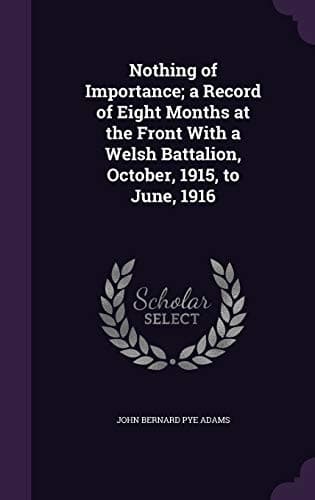
Nothing of Importance: A record of eight months at the front with a Welsh battalion, October, 1915, to June, 1916Adams, Bernard
History
Nothing of Importance: A record of eight months at the front with a Welsh battalion, October, 1915, to June, 1916
Adams, Bernard
World War, 1914-1918 -- Personal narratives, English
“Yes,” was the reply, and without more ado two stretcher-bearers turned
out and ran up 76 Street after the orderly. At that moment there was a
thud, and a blazing trail climbed up the sky from the left.
“D----,” I muttered. “We must postpone this strafe. Davidson, we’ll
fix up later, see? Only no firing now.” As Davidson disappeared to his
gun-position, I ran to the telephone.
“Trench-mortar officer,” I said. “Quick!”
But there is no “quick” about a signaller. He is always there, and
methodically, without haste or flurry, he takes down and sends
messages. There is no “quickness”; yet there is no delay. If the world
outside pulses and rocks under a storm of shells, in the signallers’
dug-out is always a deep-sea calm. So impatiently I watched the
operator beat his little tattoo on the buzzer; looked at his face,
as the candle-light shone on it, with its ears hidden beneath the
receiver-drums, and its head swathed by the band that holds them over
the ears. In the corner, the second signaller sat up and peered out of
his blanket, and then lay down again.
“Zx? Is there an officer there? Hold on a minute, please. The officer’s
at the gun, sir; will you speak to the corporal?”
“Yes.” I already had the receiver to my ear.
“Is that the trench-mortar corporal? Well, go and tell Mr. Macfarlane,
will you, to stop firing at once, and not to start again till he hears
from Mr. Adams. Right. Right. Thanks.” This last to the signaller as
I left the dug-out.
“Thud!” and another football blazed through the sky.
Macfarlane was the officer in charge of the trench-mortar guns of our
sector. I knew him well. Davidson was in charge of the Stokes gun,
which is a quick-firing trench-mortar gun. Macfarlane’s shells were
known as “footballs,” but as they had a handle attached they looked
more like hammers as they slowly curved through the air.
We had arranged to “strafe” a certain position in the German support
line at five minutes after midnight. But I wanted to stop it before
retaliation started. The doctor had gone up the front line, and
Robertson would be brought down any minute.
Outside I met Brock. He said little, but it was good to have him there.
A long while it seemed, waiting. I started up 76 Street. No sooner had
I started than I heard footsteps coming down, and to make room I went
back. I was preparing to say some cheery word to Robertson, but when I
saw him he was lying quite still and unconscious. I stopped the little
doctor.
“Is he bad, Doc?”
“Well, old man, I can hardly say. He’s got a fighting chance,” and
he went on. Slowly I heard the stretcher-bearers’ footsteps growing
fainter and fainter, and there was silence. Thank God! those footballs
had stopped now!
Public-domain text, read in full here on John Shaqi.
Reviews
Reviews
No reviews yet
Be the first to share your thoughts on this work.
Elsewhere in the archive
Join the Discussion
Join the discussion
Sign in to leave a comment or review.
Sign InorCreate an account