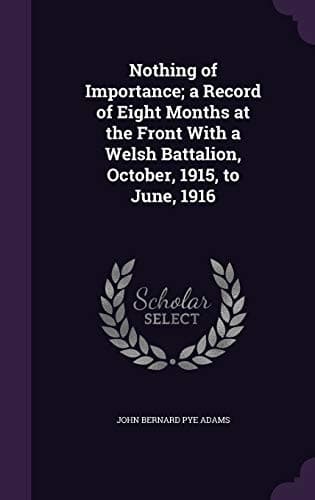
Nothing of Importance: A record of eight months at the front with a Welsh battalion, October, 1915, to June, 1916Adams, Bernard
History
Nothing of Importance: A record of eight months at the front with a Welsh battalion, October, 1915, to June, 1916
Adams, Bernard
World War, 1914-1918 -- Personal narratives, English
Then the “F.L.O.” came in. He is the “Forward liaison officer,” an
artillery officer who lives up with the infantry and facilitates
co-operation between the two. At the same moment came a cheery Scotch
voice outside, and Macfarlane, the “football” officer, looked in.
“Come oot a’ that!” he cried. “Sittin’ indoors on a fine mornin’.”
“Come in,” we said.
But his will prevailed, and we all came out into the sunshine. I had
not seen him since last night’s little show. Now he was being relieved
by another officer for six days, and I was anxious to know what sort
of a man was his successor. But Macfarlane did not know much about him
yet.
“Anyway,” said I, “if he’ll only fire like you, we don’t mind.”
“Och!” grunted Macfarlane. “What’s the use of havin’ a gun, and no
firin’ it? So long as I get ma footballs up, I’ll plunk them over aw
recht.”
“Yes,” I added. “The Boche doesn’t approve of your sort.”
For there were other sorts. There was the trench-mortar officer who
was never to be found, but who left a sergeant with instructions not
to fire without his orders; there was the trench-mortar officer who
“could not fire except by Brigade orders”; there was the trench-mortar
officer who was “afraid of giving his position away”; there was the
trench-mortar officer who “couldn’t get any ammunition up, you know;
they won’t give it me; only too pleased to fire, if only ...”; there
was the trench-mortar officer who started firing on his own, without
consulting the company commander, just when you had a big working-party
in the front trenches; and lastly there were trench-mortar officers
like Davidson and Macfarlane.
“Cheero, then,” we said, as Macfarlane went off. “Look us up. You know
our billet? We’ll be out to-morrow.”
Then we finished our consultation and divided off to our different jobs.
All that day I felt that there was in me something which by all
rights should have “given”: these two deaths should have made me feel
different: and yet I was just the same. As I went round the trench,
with Davies at my heels, talking to platoon-sergeants, examining wire
through my periscope, all in the ordinary way exactly as before, I
forgot all about Tommy and Robertson. Even when I came to the place
where Robertson had been hit, and saw the blood on the fire-step, and
some scraps of cotton wool lying about, I looked at it as you might
look at a smashed egg on the pavement, curiously, and then passed on.
“Am I indifferent to these things, then?” I asked myself. I had not
realised yet that violent emotion very rarely comes close upon the
heels of death, that there is a numbness, a blunting of the spirit,
that is an anodyne to pain. I was ashamed of my indifference; yet I
soon saw that it was no uncommon thing. Besides, one had to “carry on”
just the same. There was always a silence among the men, when a pal
“goes west”; so now Edwards and I did not talk much, except to discuss
the ordinary routine.
Public-domain text, read in full here on John Shaqi.
Reviews
Reviews
No reviews yet
Be the first to share your thoughts on this work.
Elsewhere in the archive
Join the Discussion
Join the discussion
Sign in to leave a comment or review.
Sign InorCreate an account