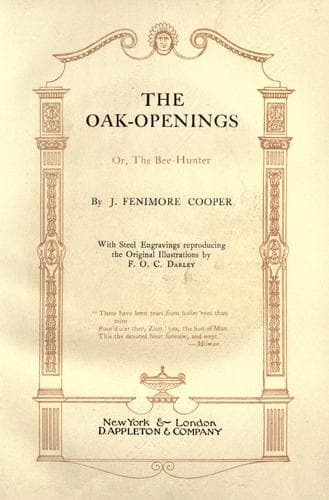
American fiction -- 19th century; Historical fiction; Indians of North America -- Fiction
Although the conjecture just mentioned was exceedingly unpleasant to le
Bourdon, the chase of the strange canoe gave him an opportunity to drag
his own light craft ahead, penetrating deeper and deeper among the wild
rice, which now spread itself to a considerable distance from the shore,
and grew so thick as to make it impossible to get through the waving
mass. At length, wearied with his exertions, and a little uncertain as
to his actual position, our hero paused, listening intently, in order to
catch any sounds that might direct his future movements.
By this time the savages ceased to call to each other; most probably
conscious of the advantage it gave the fugitive. The bee-hunter
perfectly understood that his pursuers must be aware of its being
entirely out of his power to get to windward, and that they would keep
along the shore of the river, as he did himself, expecting to see his
canoe sooner or later driven by the wind on the beach. This had made him
anxious to drag his boat as much toward the outer edge of the rice as
he could get it, and by the puffs of wind that he occasionally felt, he
hoped he had, in a great measure, effected his purpose. Still he had his
apprehensions of the savages; as some would be very apt to swim quite
out into the stream, not only to look for him, but to avoid being
entangled among the plants. It was only in the natural channels of the
rice, of which there were a good many, that a swimmer could very readily
make his way, or be in much safety. By waiting long enough, moreover,
the bee-hunter was sure he should tire out his pursuers, and thus get
rid of them.
Public-domain text, read in full here on John Shaqi.
Reviews
Reviews
No reviews yet
Be the first to share your thoughts on this work.
Elsewhere in the archive
Join the Discussion
Join the discussion
Sign in to leave a comment or review.
Sign InorCreate an account