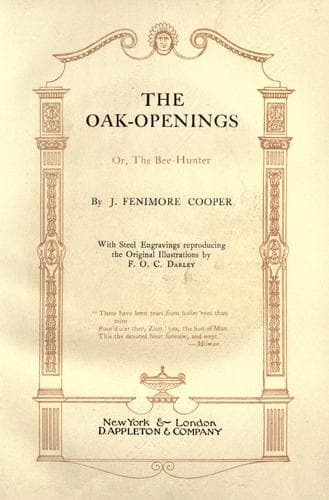
American fiction -- 19th century; Historical fiction; Indians of North America -- Fiction
The young man then related to his wondering companion the history of the
mummery and incantations of which she had been a distant spectator. Le
Bourdon's heart was light, after his hazards and escape, and his spirits
rose as his narrative proceeded. Nor was pretty Margery in a mood to
balk his humor. As the bee-hunter recounted his contrivances to elude
the savages, and most especially when he gave the particulars of the
manner in which he managed to draw whiskey out of the living rock, the
girl joined in his merriment, and filled the boat with that melody of
the laugh of her years and sex, which is so beautifully described by
Halleck.
CHAPTER X.
The things that once she loved are still the same;
Yet now there needs another name
To give the feeling which they claim,
While she the feeling gives;
She cannot call it gladness or delight;
And yet there seems to be a richer, lovelier light
On e'en the humblest thing that lives.
--WASHINGTON ALLSTON.
The history given by le Bourdon lasted until the canoes reached the
south shore. Glad enough was Dorothy to see them both safe back, for
neither of her companions had yet awoke. It was then midnight, and all
now retired to seek the rest which might be so needful to prepare them
for the exertions of the next day. The bee-hunter slept in his canoe,
while Margery shared the buffalo-skin of her sister.
As perfect security, for the moment at least, was felt by the sleepers,
their slumbers were sound, and reached into the morning. Then le Bourdon
arose, and withdrawing to a proper distance, he threw off his clothes
and plunged into the stream, in conformity with a daily practice of his
at that genial season of the year. After bathing, the young man ascended
a hill, whence he might get a good view of the opposite shore, and
possibly obtain some notion of what the Pottawattamies were about. In
all his movements, however, the bee-hunter had an eye to the concealment
of his person, it being of the last importance that the savages should
not learn his position. With the intention of concealment, the fire had
been suffered to go down, a smoke being a sign that no Indian would be
likely to overlook. As for the canoe and the bivouac of the party, the
wild rice and an intermediate hill formed a perfect cover, so long as
nothing was shown above them.
Public-domain text, read in full here on John Shaqi.
Reviews
Reviews
No reviews yet
Be the first to share your thoughts on this work.
Elsewhere in the archive
Join the Discussion
Join the discussion
Sign in to leave a comment or review.
Sign InorCreate an account