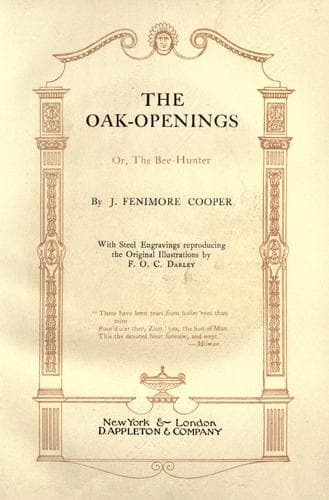
American fiction -- 19th century; Historical fiction; Indians of North America -- Fiction
Le Bourdon thought intently, during breakfast, of the condition of his
party, and of the best mode of proceeding, while the pallid and anxious
young creature at his side believed he was deliberating solely on the
best means of extricating himself and his store of honey, from the
savages on the other shore. Had the acquaintance between these young
people been of longer date than it actually was, Margery could not
have entertained a notion so injurious to the bee-hunter, for a single
moment; but there was nothing either violent, or depreciating, in
supposing that one so near being a total stranger would think first of
himself and his own interests, in the situation in which this young man
was now placed.
Little was said during the meal. Dorothy was habitually silent; the
result of grief and care. As for her husband, he was too stupid to
talk, though usually somewhat garrulous; while the Indian seldom did
two things at the same time. This was the hour for acting; when that
for talking should arrive, he would be found equal to its duties.
Pigeonswing could either abstain from food, or could indulge in it
without measure, just as occasion offered. He had often gone for
days without tasting a mouthful, with the exception of a few berries,
perhaps; and he had lain about the camp-fire, a week at a time, gorging
himself with venison, like an anaconda. It is perhaps fortunate for the
American Indian, that this particular quality of food is so very easy of
digestion, since his excesses on it are notorious, and so common to his
habits as almost to belong to his nature. Death might otherwise often be
the consequence.
When the breakfast was ended, it was time to consult about the future
course. As yet, the Pottawattamies had made no new discovery; but the
sagacity of the red man was ever to be feared, when it came to be merely
a question of finding his foe in a forest.
“We have obtained one advantage over the enemy,” said le Bourdon, “by
crossing the river. Water leaves no trail; even had Crowsfeather a
canoe, he might not know where to go in it, in order to find us.”
“Dat not so,” put in the Chippewa, a little dogmatically; “know we hab
canoe--know cross river in him.”
“Why should they know this, Pigeonswing? We may have gone out upon the
lake, or we may have gone up in the oak openings again, for anything the
Pottawattamies can know to the contrary.”
“Tell you, not so. Know don't go on lake, cause wind blow. Know don't
go up river, cause dat hard work; know come here, cause dat easy. Injin
like to do what easy, and pale-face do just what Injin do. Crowsfeather
make raft, pretty soon; den he come look arter scalp.”
“Yes,” said Margery, gently; “you had better load your canoe at once,
and go on the lake, while the savages cannot reach you. The wind is fair
for them that are to go north; and I have heard you say that you are
bound to Mackinaw.”
Public-domain text, read in full here on John Shaqi.
Reviews
Reviews
No reviews yet
Be the first to share your thoughts on this work.
Elsewhere in the archive
Join the Discussion
Join the discussion
Sign in to leave a comment or review.
Sign InorCreate an account