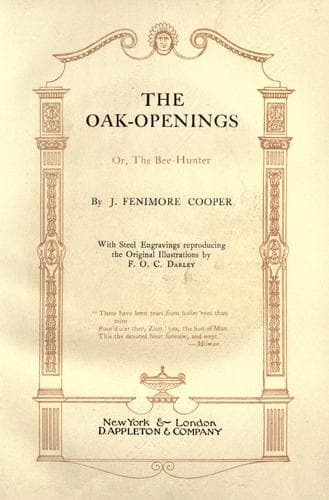
American fiction -- 19th century; Historical fiction; Indians of North America -- Fiction
“Amen” was not the real name of the missionary ; but it was a
_sobriquet_ bestowed by the soldiers, on account of the unction with
which this particular word was ordinarily pronounced, and quite likely,
too, because it was the word of all others most pleasant to their ears,
after a sermon, or a prayer. It had, by long use, got to be so familiar,
that the men did not scruple to use it to the good man's face. This
missionary was a Methodist ; a sect that possessed, in that day, very
few clergymen of education, most of its divines coming of a class in
life that did not predispose them to take offence at light invasions on
their dignity, and whose zeal and habitual self-denial had schooled them
into a submission to far more positive personal privations, than any
connected with the mere tongue. That there are “wolves in sheep's
clothing” among the Methodists, as well as among the other religious
sects of the country, our daily experience shows ; but the mind must be
sadly inclined to believe evil of others, which does not see in the
humble and untiring efforts of this particular sect of Christians, more
than mere fanaticism or hypocrisy can produce.
“You are right, corporal,” returned the missionary ; “since this is the
case, I see no better course for us to pursue, than to put ourselves
altogether in the hands of Onoah. He has counselled us well, hitherto,
and will do better by us than any other guide to be found, out in this
wilderness.”
Le Bourdon could scarcely trust his sense of hearing ! Onoah was the
Indian appellation of the terrible and most dreaded savage, who, in
English, went by the name of Scalping Peter, or “Scalping Pete,” among
all the white dwellers on that frontier, and at all the garrisons of the
Americans, far and near. The Indian name, indeed, was said to mean
“scalp,” in several of the dialects of the Iroquois. Perhaps it may be
well, also, to explain here, that the term “garrison” did not imply, in
the language of that region, the troops only who garrisoned a post, but
it was even oftener applied to the post itself than to those who held
it. Thus old, empty, and deserted forts, those that have actually been
abandoned, and are devoted to decay, are almost universally styled the ”
garrisons,” even though a soldier had not put foot in them for a quarter
of a century. This is one of the proofs of the convertible nature of our
language, of which the country affords so many, and which has changed
the smaller-sized rivers into “creeks,” “lakes” into “ponds,” “squares”
into “parks,” public promenades on the water into “batteries”; to all of
which innovations, bad as they may be, and useless and uncalled for, and
wanton as they are, we are much more willing to submit, than to the new-
fangled and lubberly abomination of saying “ON a steamboat,” or “ON a
ship.”
Public-domain text, read in full here on John Shaqi.
Reviews
Reviews
No reviews yet
Be the first to share your thoughts on this work.
Elsewhere in the archive
Join the Discussion
Join the discussion
Sign in to leave a comment or review.
Sign InorCreate an account