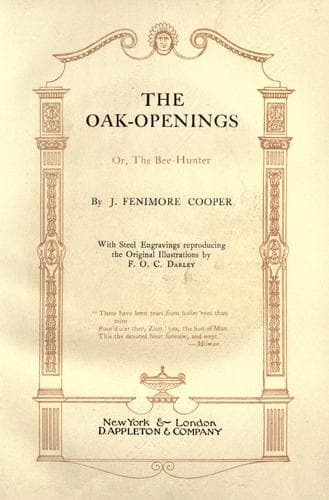
American fiction -- 19th century; Historical fiction; Indians of North America -- Fiction
“How can you help it, if they be so minded? You are but a single man,
and they are twenty.”
On hearing this, Corporal Flint pricked up his ears, and stood if
possible more erect than ever, for he considered himself a part of a man
at least, and one moreover who had served in all the wars of the west,
from the great battle of St. Glair to that of Mad Anthony. He was spared
the necessity of a reply, however, for Peter made a significant gesture
which as much as told him that he would take that office on himself.
“No need be afeard,” said Peter, quietly. “Know Pottawattamie--know all
chief. Nobody touch canoe of Onoah when he say don't touch him.”
“Yet they are Injins of the British, and I see you here in company with
a soldier of Uncle Sam.”
“No matter; Onoah go just where he please. Sometime to Pottawattamie;
sometime to Iroquois. All Ojebways know Onoah. All Six Nation know him
well. All Injin know him. Even Cherokee know him now, and open ears when
he speak. Muss cross river, and shake hand with Crowsfeather.”
There was nothing boastful, or vaunting, in Peter's manner while he
thus announced his immunity or power, but he alluded to it in a quiet,
natural way, like one accustomed to being considered a personage of
consequence. Mankind, in general, make few allowances for the influence
of habit; the sensibilities of the vainglorious themselves being quite
as often wounded by the most natural and direct allusions of those who
enjoy advantages superior to their own, as by those that are intended to
provoke comparisons. In the present instance, however, no such feeling
could exist, the Indian asserting no more than his extended reputation
would fully maintain.
When Peter had thus expressed himself, the missionary thought it meet to
add a few words in explanation. This he did, however, aside, walking a
little apart with the bee-hunter, in order so to do. As for Gershom,
no one seemed to think him of sufficient importance to throw away any
interest or care on him.
“You can trust to Peter, friend bee-hunter,” the missionary observed,
“for what he promises he will perform. I know him well, and have put
myself altogether in his hands. If he says that the Pottawattamies are
not to have his canoe, the Pottawattamies will not get it. He is a man
to be depended on.”
“Is not this, then, Scalping Peter, who bears so terrible a name on all
this frontier?” demanded le Bourdon.
“The same; but do not disturb yourself with names: they hurt no one, and
will soon be forgotten. A descendant of Abraham, and of Isaac, and of
Jacob, is not placed in the wilderness by the hand of divine power for
no purpose; since he is here, rely on it, it is for good.”
“A descendant of Abraham, and Isaac, and Jacob! Is not Peter, then, a
red-skin and an Injin?”
Public-domain text, read in full here on John Shaqi.
Reviews
Reviews
No reviews yet
Be the first to share your thoughts on this work.
Elsewhere in the archive
Join the Discussion
Join the discussion
Sign in to leave a comment or review.
Sign InorCreate an account