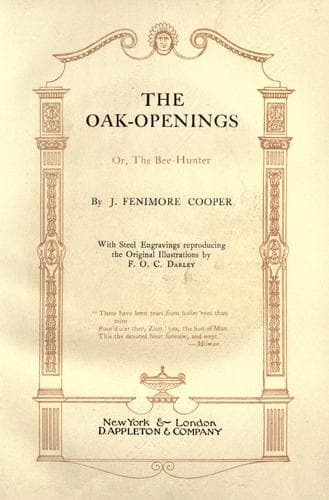
American fiction -- 19th century; Historical fiction; Indians of North America -- Fiction
It is a singular fact that, while such men as Tecumseh, his brother the
Prophet, and Peter, were looking forward to the downfall of the republic
on the side of the forest, so many, who ought to have been better
informed on such a subject, were anxiously expecting, nay confidently
predicting it, from beyond the Atlantic. Notwithstanding these sinister
soothsayers, the progress of the nation has, by a beneficent Providence,
been onward and onward, until it is scarcely presumptuous to suppose
that even England has abandoned the expectation of classing this country
again among her dependencies. The fortunes of America, under God, depend
only on herself. America may destroy America; of that there is danger;
but it is pretty certain that Europe united could make no serious
impression on her. Favored by position, and filled with a population
that we have ever maintained was one of the most military in existence,
a truth that recent events are hourly proving to be true, it much
exceeds the power of all the enemies of her institutions to make any
serious impression on her. There is an enemy who may prove too much for
her; it exists in her bosom; and God alone can keep him in subjection,
and repress his desolation.
These were facts, however, of which Wa-wa-nosh, or Onoah, was as
ignorant as if he were an English or French minister of state, and had
got his notions of the country from English or French travellers, who
wished for what they predicted. He had heard of the towns and population
of the republic; but one gets a very imperfect notion of any fact of
this sort by report, unless previous experience has prepared the mind
to make the necessary comparisons, and fitted it to receive the images
intended to be conveyed. No wonder, then, that Peter fell into a mistake
common to those who had so many better opportunities of forming just
opinions, and of arriving at truths that were sufficiently obvious to
all who did not wilfully shut their eyes to their existence.
CHAPTER XIII.
Hearest thou voices on the shore
That our ears perceive no more,
Deafened by the cataract's roar?
Bear, through sorrow, wrong, and ruth,
In thy heart the dew of youth,
On thy lips the smile of truth.
--LONGFELLOW.
From all that has been stated, the reader will, probably, be prepared to
learn that Boden did not succeed in his effort to persuade Gershom,
and the other Christians, to accompany him on his voyage round by Lake
Huron. Corporal Flint was obdurate, and Parson Amen confiding. As for
Gershom, he did not like the thought of retracing his steps so soon, and
the females were obliged to remain with the husband and brother.
Public-domain text, read in full here on John Shaqi.
Reviews
Reviews
No reviews yet
Be the first to share your thoughts on this work.
Elsewhere in the archive
Join the Discussion
Join the discussion
Sign in to leave a comment or review.
Sign InorCreate an account