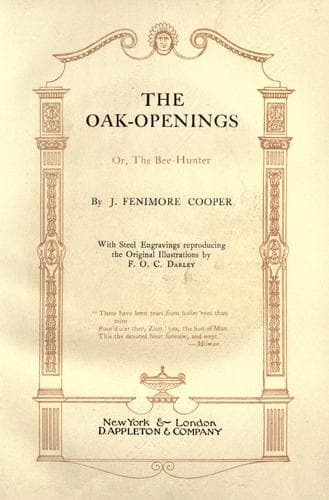
American fiction -- 19th century; Historical fiction; Indians of North America -- Fiction
As for the council, its members were moved by more than ordinary
curiosity to hear what further the missionary might have to say, though
all present succeeded admirably in suppressing the exhibition of
any interest that might seem weak and womanly. After a decent delay,
therefore, Bear's Meat intimated to the parson that it would be
agreeable to the chiefs present to listen to him further.
“My children, I have a great tradition to tell you,” the missionary
resumed, as soon as on his feet again; “a very great and divine
tradition; not a tradition of man's, but one that came direct from the
Manitou himself. Peter has spoken truth; there is but one Great Spirit;
he is the Great Spirit of all colors, and tribes, and nations. He made
all men of the same clay.” Here a slight sensation was perceptible among
the audience, most of whom were very decidedly of a different opinion,
on this point of natural history. But the missionary was now so far
warmed with his subject as to disregard any slight interruption, and
proceeded as if his listeners had betrayed no feeling. “And he divided
them afterward into nations and tribes. It was then he caused the color
of his creatures to change. Some he kept white, as he had made them.
Some he put behind a dark cloud, and they became altogether black. Our
wise men think that this was done in punishment for their sins. Some he
painted red, like the nations on this continent.” Here Peter raised a
finger, in sign that he would ask a question; for, without permission
granted, no Indian would interrupt the speaker. Indeed, no one of less
claims than Peter would hardly have presumed to take the step he now
did, and that because he saw a burning curiosity gleaming in the bright
eyes of so many in the dark circle.
“Say on, Peter,” answered the missionary to this sign; “I will reply.”
“Let my brother say WHY the Great Spirit turned the Indian to a red
color. Was he angry with him? or did he paint him so out of love?”
“This is more than I can tell you, friends. There are many colors among
men, in different parts of the world, and many shades among people of
the same color. There are pale-faces fair as the lily, and there are
pale-faces so dark, as scarcely to be distinguished from blacks. The
sun does much of this; but no sun, nor want of sun, will ever make a
pale-face a red-skin, or a red skin a pale-face.”
“Good--that is what we Indians say. The Manitou has made us different;
he did not mean that we should live on the same hunting-grounds,”
rejoined Peter, who rarely failed to improve every opportunity in order
to impress on the minds of his followers the necessity of now crushing
the serpent in its shell.
Public-domain text, read in full here on John Shaqi.
Reviews
Reviews
No reviews yet
Be the first to share your thoughts on this work.
Elsewhere in the archive
Join the Discussion
Join the discussion
Sign in to leave a comment or review.
Sign InorCreate an account