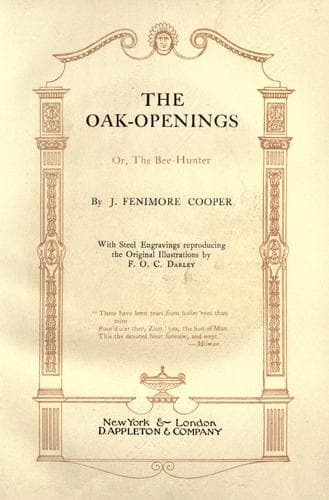
American fiction -- 19th century; Historical fiction; Indians of North America -- Fiction
“Good or bad, I wish there were fewer of them, and that they were
farther off. This man Peter is a mystery to me: sometimes he seems quite
friendly; then, ag'in, he appears just ready to take all our scalps. Do
you know much of his past history, Mr. Amen?”
“Not as much as I wish I did,” the missionary replied. “No one can tell
me aught concerning Peter, beyond the fact of his being a sort of a
prophet, and a chief of commanding influence. Even his tribe is unknown;
a circumstance that points us to the ancient history of the Jews for the
explanation. It is my own opinion that Peter is of the race of Aaron,
and that he is designed by Divine Providence to play an important
part in the great events on which we touch. All that is wanting is, to
persuade HIM into this belief, himself. Once persuade a man that he is
intended to be something, and your work is half done to your hands. But
the world is so full of ill-digested and random theories, that truth has
as much as it can do to obtain a sober and patient hearing!”
Thus is it with poor human nature. Let a man get a crotchet into his
head--however improbable it may be, however little supported by reason
or fact, however ridiculous, indeed--and he becomes indisposed to
receive any evidence but that which favors his theory; to see any truths
but such as he fancies will harmonize with HIS truths; or to allow
of any disturbing causes in the great workings of his particular
philosophy. This notion of Parson Amen's concerning the origin of
the North American savage, did not originate with that simple-minded
enthusiast, by any means. In this way are notions formed and nurtured.
The missionary had read somewhat concerning the probability that the
American Indians were the lost tribes of Israel; and possessed with the
idea, everything he saw was tortured into evidence in support of his
theory. There is just as much reason for supposing that any, and all, of
the heathen savages that are scattered up and down the earth have this
origin, as to ascribe it to our immediate tribes; but to this truth the
good parson was indifferent, simply because it did not come within the
circle of his particular belief.
Thus, too, was it with the corporal. Unless courage, and other military
qualities, were manifested precisely in the way in which HE had been
trained, they were not courage and military qualities at all. Every
virtue has its especial and conventional accessories, according to this
school of morals; nothing of the sort remaining as it came from above,
in the simple abstract qualities of right and wrong. On such feelings
and principles as these, do men get to be dogmatical, narrow-minded, and
conceited!
Public-domain text, read in full here on John Shaqi.
Reviews
Reviews
No reviews yet
Be the first to share your thoughts on this work.
Elsewhere in the archive
Join the Discussion
Join the discussion
Sign in to leave a comment or review.
Sign InorCreate an account