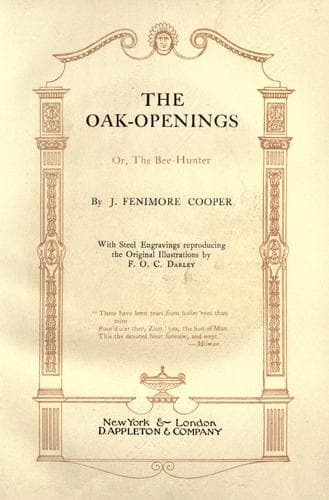
American fiction -- 19th century; Historical fiction; Indians of North America -- Fiction
One, ignorant of the state of political affairs on the American
continent, and who was not aware of the vicinity of savages, would
have seen nothing that morning, as the party proceeded on its little
excursion, in and around that remote spot, but a picture of rural
tranquillity and peace. A brighter day never poured its glories on the
face of the earth; and the Openings, and the glades, and even the dark
and denser forests, were all bathed in the sunlight, as that orb is
known to illuminate objects in the softer season of the year, and in the
forty-third degree of latitude. Even the birds appeared to rejoice in
the beauties of the time, and sang and fluttered among the oaks, in
numbers greater than common. Nature usually observes a stern fitness in
her adaptation of means to ends. Birds are to be found in the forests,
on the prairies, and in the still untenanted openings of the west--and
often in countless numbers; more especially those birds which fly in
flocks, and love the security of unoccupied regions--unoccupied by
man is meant--wherein to build their nests, obey the laws of their
instincts, and fulfil their destinies. Thus, myriads of pigeons, and
ducks, and geese, etc., are to be found in the virgin woods, while the
companionable and friendly robin, the little melodious wren, the thrush,
the lark, the swallow, the marten, and all those pleasant little winged
creatures, that flit about our dwellings and grounds, and seem to be
sent by Providence, expressly to chant their morning and evening hymns
to God in our ears, most frequent the peopled districts. It has been
said by Europeans that the American birds are mute, in comparison with
those of the Old World. This is true, to a certain extent, as respects
those which are properly called forest birds, which do, in general,
appear to partake of the sombre character that marks the solemn
stillness of their native haunts. It is not true, however, with the
birds which live in our fields, and grounds, and orchards, each of which
sings its song of praise, and repeats its calls and its notes, as richly
and as pleasantly to the ear, as the birds of other lands. One large
class, indeed, possesses a faculty that enables it to repeat every note
it has ever heard, even to some of the sounds of quadrupeds. Nor is this
done in the discordant tones of the parrot; but in octaves, and trills,
and in rich contra-altos, and all the other pleasing intonations known
to the most gifted of the feathered race. Thus it is, that one American
mocking-bird can outsing all the birds of Europe united.
Public-domain text, read in full here on John Shaqi.
Reviews
Reviews
No reviews yet
Be the first to share your thoughts on this work.
Elsewhere in the archive
Join the Discussion
Join the discussion
Sign in to leave a comment or review.
Sign InorCreate an account