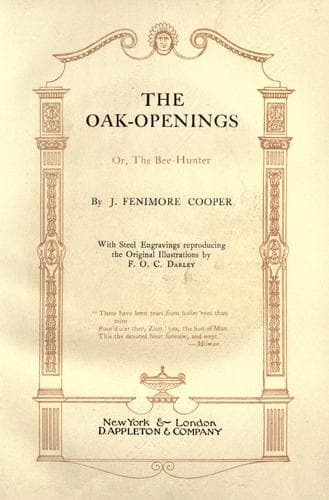
American fiction -- 19th century; Historical fiction; Indians of North America -- Fiction
On Prairie Round there was even a higher stamp of seeming
civilization--seeming, since it was nature, after all, that had mainly
drawn the picture. In the first place, the spot had been burnt so
recently, as to leave the entire expanse covered with young grasses and
flowers, the same as if it were a well-kept park. This feature, at
that advanced period of the summer, was in some degree accidental, the
burning of the prairies depending more or less on contingencies of that
sort. We have now less to do with the cause, than with its consequences.
These were most agreeable to the eye, as well as comfortable to the
foot, the grass nowhere being of a height to impede movement, or,
what was of still more importance to le Bourdon's present pursuit, to
overshadow the flowers. Aware of this fact, he had led his companions
all that distance, to reach this scene of remarkable rural beauty, in
order that he might make a grand display of his art, in presence of the
assembled chiefs of that region. The bee-hunter had pride in his craft,
the same as any other skilful workman who had gained a reputation by
his cunning, and he now trod the prairie with a firmer step, and a more
kindling eye, than was his wont in the commoner haunts of his calling.
Men were there whom it might be an honor to surprise, and pretty Margery
was there also, she who had so long desired to see this very exhibition.
But to revert once more to the prairie, ere we commence the narrative
of what occurred on it. This well-known area is of no great extent,
possessing a surface about equal to that of one of the larger parks
of Europe. Its name was derived from its form, which, without being
absolutely regular, had so near an approach to a circle as to justify
the use of the appellation. The face of this charming field was neither
waving, or what is called “rolling,” nor a dead flat, as often occurs
with river bottoms. It had just enough of undulation to prevent too much
moisture, and to impart an agreeable variety to its plain. As a whole,
it was clear of the forest; quite as much so as if the axe had done its
work there a thousand years before, though wood was not wanting. On the
contrary, enough of the last was to be seen, in addition to that which
formed the frame of this charming landscape, to relieve the view from
all appearance of monotony, and to break it up into copses, thickets,
trees in small clusters, and in most of the varieties that embellish
native scenery. One who had been unexpectedly transferred to the spot,
might well have imagined that he was looking on the site of some old
and long-established settlement, from which every appliance of human
industry had been suddenly and simultaneously abstracted. Of houses,
out-buildings, fences, stacks, and husbandry, there were no signs;
unless the even and verdant sward, that was spread like a vast carpet,
sprinkled with flowers, could have been deemed a sign of the last. There
Public-domain text, read in full here on John Shaqi.
Reviews
Reviews
No reviews yet
Be the first to share your thoughts on this work.
Elsewhere in the archive
Join the Discussion
Join the discussion
Sign in to leave a comment or review.
Sign InorCreate an account