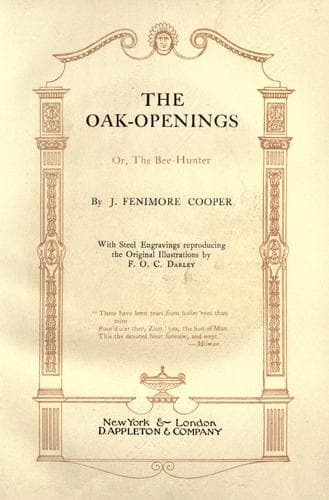
American fiction -- 19th century; Historical fiction; Indians of North America -- Fiction
The bee-hunter was able to foresee this, by knowing which insect had
been longest on the comb; but so practised had his eye become, that he
knew with tolerable accuracy, by the movements of the creatures, those
that had filled themselves with honey from those that had not. As it did
not suit his purpose, however, to let all the minutiae of his craft be
known, his answer was evasive. Just at that moment a thought occurred to
him, which it might be well to carry out in full. He had once saved his
life by necromancy, or what seemed to the simple children of the woods
to be necromancy, and why might he not turn the cunning of his regular
art to account, and render it the means of rescuing the females, as well
as himself, from the hands of their captors? This sudden impulse from
that moment controlled his conduct; and his mind was constantly
casting about for the means of effecting what was now his one great
purpose-escape. Instead of uttering in reply to Bear's Meat's question
the simple truth, therefore, he rather sought for such an answer as
might make the process in which he was engaged appear imposing and
mystical.
“How do the Injins know the path of the deer?” he asked, by way of
reply. “They look at the deer, get to know him, and understand his ways.
This middle bee will soon fly.”
“Which way will he go?” asked Peter. “Can my brother tell us THAT?”
“To his hive,” returned le Bourdon, carelessly, as if he did not fully
understand the question. “All of them go to their hives, unless I tell
them to go in another direction. See, the bee is up!”
The chiefs now looked with all their eyes. They saw, indeed, that the
bee was making its circles above the stand. Presently they lost sight of
the insect, which to them seemed to vanish; though le Bourdon distinctly
traced its flight for a hundred yards. It took a direction at right
angles to that of the first bee, flying off into the prairie, and
shaping its course toward an island of wood, which might have been of
three or four acres in extent, and distant rather less than a mile.
While le Bourdon was noting this flight, another bee arose. This
creature flew toward the point of forest, already mentioned as the
destination of the insect that had first risen. No sooner was this third
little animal out of sight, than the fourth was up, humming around the
stand. Ben pointed it out to the chiefs; and this time they succeeded in
tracing the flight for, perhaps, a hundred feet from the spot where they
stood. Instead of following either of its companions, this fourth bee
took a course which led it off the prairie altogether, and toward the
habitations.
Public-domain text, read in full here on John Shaqi.
Reviews
Reviews
No reviews yet
Be the first to share your thoughts on this work.
Elsewhere in the archive
Join the Discussion
Join the discussion
Sign in to leave a comment or review.
Sign InorCreate an account