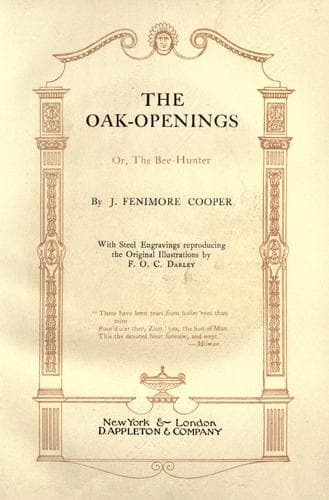
American fiction -- 19th century; Historical fiction; Indians of North America -- Fiction
As for Peter, he was more confounded than convinced. His mind was so
much superior to those of the other chiefs, as to render him far more
difficult to mislead; though even he was not exempt from the great
weaknesses of ignorance, superstition, and its concomitants--credulity,
and a love of the marvellous. His mind was troubled, as was quite
apparent to Ben, who watched HIM quite as narrowly as he was observed
himself, in all he did. Willing to deepen the impression, our artist
now determined to exhibit some of the higher fruits of his skill. The
production of a considerable quantity of honey would of itself be a sort
of peace-offering, and he now prepared to turn the certainty of there
being a hive in the little wood to account--certainty, because three
bees had taken wing for it, and a very distinct angle had been made with
two of them.
“Does my brother wish any honey?” asked le Bourdon carelessly; “or shall
I send a bee across Lake Michigan, to tell the Injins further west that
Detroit is taken?”
“Can Bourdon find honey, NOW?” demanded Peter.
“Easily. Several hives are within a mile of us. The bees like this
prairie, which is so well garnished with flowers, and I am never at a
loss for work, in this neighborhood. This is my favorite bee-ground; and
I have got all the little creatures so that they know me, and are ready
to do everything that I tell them. As I see that the chiefs love honey,
and wish to eat some, we will now go to one of my hives.”
Thus saying, le Bourdon prepared for another march. He moved with
all his appliances, Margery keeping close at his side, carrying the
honey-comb and honey. As the girl walked lightly, in advance of the
Indians, some fifteen or twenty bees, attracted by the flavor of what
she carried, kept circling around her head, and consequently around that
of Boden; and Peter did not fail to observe the circumstance. To him it
appeared as if these bees were so many accompanying agents, who attended
their master in order to do his bidding. In a word, Peter was fast
getting into that frame of mind, when all that is seen is pressed into
the support of the theory we have adopted. The bee-hunter had some
mysterious connection with, and control over the bees, and this was
one among the many other signs of the existence of his power. All this,
however, Boden himself disregarded. His mind was bent on throwing dust
into the eyes of the Indians; and he was cogitating the means of so
doing, on a much larger scale than any yet attempted.
“Why dem bee fly 'round young squaw?” demanded Peter--“and fly round
you, too?”
“They know us, and go with us to their hive; just as Injins would come
out of their villages to meet and honor visitors.”
Public-domain text, read in full here on John Shaqi.
Reviews
Reviews
No reviews yet
Be the first to share your thoughts on this work.
Elsewhere in the archive
Join the Discussion
Join the discussion
Sign in to leave a comment or review.
Sign InorCreate an account