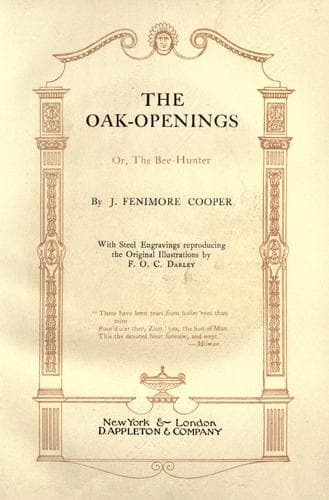
American fiction -- 19th century; Historical fiction; Indians of North America -- Fiction
They separated; the Indian with a cold smile of courtesy, but with his
ruthless intentions as respected the missionary in no degree changed.
Boden and Margery alone were exempt from vengeance, according to his
present designs. An unaccountable gentleness of feeling governed him, as
connected with the girl; while superstition, and the dread of an unknown
power, had its full influence on his determination to spare her lover.
There might be some faint ray of human feeling glimmering among the
fierce fires that so steadily burned in the breast of this savage; but
they were so much eclipsed by the brighter light that gleamed around
them, as to be barely perceptible, even to himself. The result of all
these passions was, a determination in Peter to spare those whom he had
advised the missionary to unite--making that union a mysterious argument
in favor of Margery--and to sacrifice all the rest. The red American
is so much accustomed to this species of ruthless proceeding, that the
anguish he might occasion the very beings to whom he now wished to be
merciful, gave the stern chief very little concern. Leaving the Indians
in the exclusive possession of Prairie Round, we will return to the rest
of the party.
The missionary hastened after his friends as fast as he could go. Boden
and Margery had much to say to each other in that walk, which had a
great deal about it to bring their thoughts within the circle of their
own existence. As has been said, the fire had run through that region
late, and the grasses were still young, offering but little impediment
to their movements. As the day was now near its heat, le Bourdon led his
spirited, but gentle companion, through the groves, where they had the
benefit of a most delicious shade, a relief that was now getting to be
very grateful. Twice had they stopped to drink at cool, clear springs,
in which the water seemed to vie with the air in transparency. As this
is not the general character of the water of that region, though marked
exceptions exist, Margery insisted that the water was eastern and not
western water.
“Why do we always think the things we had in childhood better than
those we enjoy afterward?” asked Margery, after making one of these
comparisons, somewhat to the disadvantage of the part of the country in
which she then was. “I can scarce ever think of home--what I call home,
and which was so long a home to me--without shedding tears. Nothing here
seems as good of its kind as what I have left behind me. Do you have the
same longings for Pennsylvania that I feel for the sea-coast and for the
rocks about Quincy?”
“Sometimes. When I have been quite alone for two or three months, I have
fancied that an apple, or a potato, or even a glass of cider that came
from the spot where I was born, would be sweeter than all the honey bees
ever gathered in Michigan.”
Public-domain text, read in full here on John Shaqi.
Reviews
Reviews
No reviews yet
Be the first to share your thoughts on this work.
Elsewhere in the archive
Join the Discussion
Join the discussion
Sign in to leave a comment or review.
Sign InorCreate an account