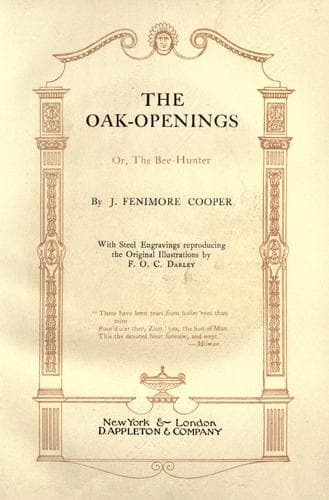
American fiction -- 19th century; Historical fiction; Indians of North America -- Fiction
“You might as well ask me, sir, what has become of the thousands of
Hebrews who turned them loose. I suppose all must be dead a thousand
years ago. Scape-goats are creatures that even Injins would not like.”
“All this is a great mystery, Bourdon--a much greater mystery than our
friend Peter, whom you have so often said was a man so unaccountable. By
the way, he has given me a charge to perform an office between you and
Margery, that I had almost forgotten. From what he said to me, I rather
think it may have some connection with our safety. We have enemies among
these savages, I feel very certain; though I believe we have also warm
friends.”
“But what have you in charge that has anything to do with Bourdon
and me?” asked the wondering Margery, who was quick to observe the
connection, though utterly at a loss to comprehend it.
The missionary now called a halt, and finding convenient seats, he
gradually opened the subject with which he had been charged by Peter to
his companions. The reader is probably prepared to learn that there was
no longer any reserve between le Bourdon and Margery on the subject of
their future marriage. The young man had already pressed an immediate
union, as the wisest and safest course to be pursued. Although the
savage American is little addicted to abusing his power over female
captives, and seldom takes into his lodge an unwilling squaw, the
bee-hunter had experienced a good deal of uneasiness on the score of
what might befall his betrothed. Margery was sufficiently beautiful
to attract attention, even in a town; and more than one fierce-looking
warrior had betrayed his admiration that very day, though it was in a
very Indian-like fashion. Rhapsody, and gallant speeches, and sonnets,
form no part of Indian courtship; but the language of admiration is
so very universal, through the eyes, that it is sufficiently easy of
comprehension. It was possible that some chief, whose band was too
formidable to be opposed, might take it into his head to wish to see a
pale-face squaw in his wigwam; and, while it was not usual to do much
violence to a female's inclinations on such occasions, it was not common
to offer much opposition to those of a powerful warrior. The married
tie, if it could be said to exist at all, however, was much respected;
and it was far less likely that Margery, a wife, would thus be
appropriated, than Margery, unmarried. It is true, cases of unscrupulous
exercise of power are to be found among Indians, as well as among
civilized men, but they are rare, and usually are much condemned.
Public-domain text, read in full here on John Shaqi.
Reviews
Reviews
No reviews yet
Be the first to share your thoughts on this work.
Elsewhere in the archive
Join the Discussion
Join the discussion
Sign in to leave a comment or review.
Sign InorCreate an account