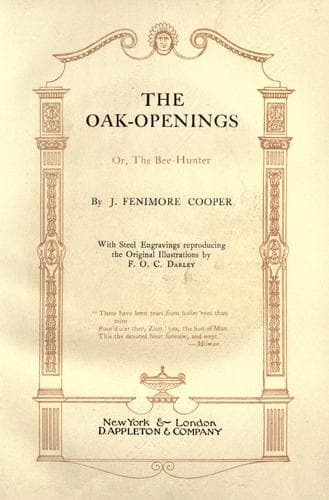
American fiction -- 19th century; Historical fiction; Indians of North America -- Fiction
Having uttered this brief but sententious account of his view of the
matter at issue, the chief resumed his seat, reasonably well satisfied
with this, his second attempt to be eloquent that day. His success
this time was not as unequivocal as on the former occasion, but it
was respectable. Several of the chiefs saw a reasonable, if not a very
logical analogy, between a man's name and his mind; and to them it
appeared a tolerably fair inference that a man should act up to his
name. If his name was tough, he ought to be tough, too. In this it does
not strike us that they argued very differently from civilized beings,
who are only too apt to do that which their better judgments really
condemn, because they think they are acting “in character,” as it is
termed.
Ungque was both surprised and delighted with this unexpected support
from Bough of the Oak. He knew enough of human nature to understand
that a new-born ambition, that of talking against the great, mysterious
chief, Peter, was at the bottom of this unexpected opposition; but
with this he was pleased, rather than otherwise. An opposition that
is founded in reason, may always be reasoned down, if reasons exist
therefor; but an opposition that has its rise in any of the passions,
is usually somewhat stubborn. All this the mean-looking chief, or the
Weasel, understood perfectly, and appreciated highly. He thought the
moment favorable, and was disposed to “strike while the iron was hot.”
Rising after a decent interval had elapsed, this wily Indian looked
about him, as if awed by the presence in which he stood, and doubtful
whether he could venture to utter his thoughts before so many wise
chiefs. Having made an impression by this air of diffidence, he
commenced his harangue.
“I am called the Weasel,” he said, modestly. “My name is not taken from
the mightiest tree of the forest, like that of my brother; it is taken
from a sort of rat--an animal that lives by its wits. I am well named.
When my tribe gave me that name, it was just. All Injins have not names.
My great brother, who told us once that we ought to take the scalp of
every white man, but WHO now tells us that we ought not to take the
scalp of every white man, has no name. He is called Peter, by the
pale-faces. It is a good name. But it is a pale-face name. I wish we
knew the real name of my brother. We do not know his nation or his
tribe. Some say he is an Ottawa, some an Iowa, some even think him a
Sioux. I have heard he was a Delaware, from toward the rising sun.
Some, but they must be Injins with forked tongues, think and say he is
a Cherokee! I do not believe this. It is a lie. It is said to do my
brother harm. Wicked Injins will say such things. But we do not mind
what THEY say. It is not necessary.
Public-domain text, read in full here on John Shaqi.
Reviews
Reviews
No reviews yet
Be the first to share your thoughts on this work.
Elsewhere in the archive
Join the Discussion
Join the discussion
Sign in to leave a comment or review.
Sign InorCreate an account