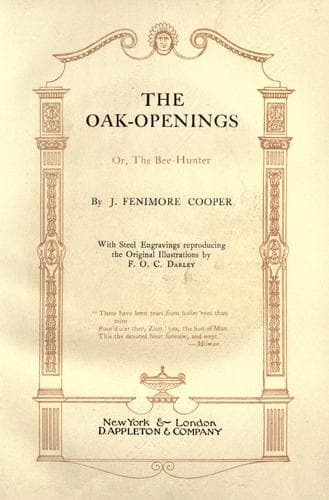
American fiction -- 19th century; Historical fiction; Indians of North America -- Fiction
“Brother, we think much better of you since you killed The Weasel, and
hurt our young men. If all your warriors at Chicago had been as bold
as you, Black-Bird would not have taken that fort. You would have saved
many scalps. This encourages us. It makes us think the Great Spirit
means to help us, and that we shall kill all the pale-faces. When we get
further into your settlements, we do not expect to meet many such braves
as you. They tell us we shall then find men who will run, and screech
like women. It will not be a pleasure to torment such men. We had
rather torment a bold warrior, like you, who makes us admire him for his
manliness. We love our squaws, but not in the warpath. They are best
in the lodges; here we want nothing but men. You are a man--a brave--we
honor you. We think, notwithstanding, we shall yet make you weak. It
will not be easy, yet we hope to do it. We shall try. We may not think
quite so well of you, if we do it; but we shall always call you a brave.
A man is not a stone. We can all feel, and when we have done all that is
in our power, no one can do more. It is so with Injins; we think it must
be so with pale-faces. We mean to try and see how it is.”
The corporal understood very little of this harangue, though he
perfectly comprehended the preparations of the saplings, and Bough of
the Oak's allusions to THEM. He was in a cold sweat at the thought, for
resolute as he was, he foresaw sufferings that human fortitude could
hardly endure. In this state of the case, and in the frame of mind he
was in, he had recourse to an expedient of which he had often heard,
and which he thought might now be practised to some advantage. It was to
open upon the savages with abuse, and to exasperate them, by taunts and
sarcasm, to such a degree as might induce some of the weaker members
of the tribe to dispatch him on the spot. As the corporal, with the
perspective of the saplings before his eyes, manifested a good deal of
ingenuity on this occasion, we shall record some of his efforts.
“D'ye call yourselves chiefs and warriors?” he began, upon a pretty high
key. “I call ye squaws! There is not a man among ye. Dogs would be the
best name. You are poor Injins. A long time ago, the pale-faces came
here in two or three little canoes. They were but a handful, and you
were plentier than prairie wolves. Your bark could be heard throughout
the land. Well, what did this handful of pale-faces? It drove your
fathers before them, until they got all the best of the hunting-grounds.
Not an Injin of you all, now, ever get down on the shores of the great
salt lake, unless to sell brooms and baskets, and then he goes sneaking
like a wolf after a sheep. You have forgotten how clams and oysters
taste. Your fathers had as many of them as they could eat; but not one
of YOU ever tasted them. The pale-faces eat them all. If an Injin asked
for one, they would throw the shell at his head, and call him a dog.
Public-domain text, read in full here on John Shaqi.
Reviews
Reviews
No reviews yet
Be the first to share your thoughts on this work.
Elsewhere in the archive
Join the Discussion
Join the discussion
Sign in to leave a comment or review.
Sign InorCreate an account