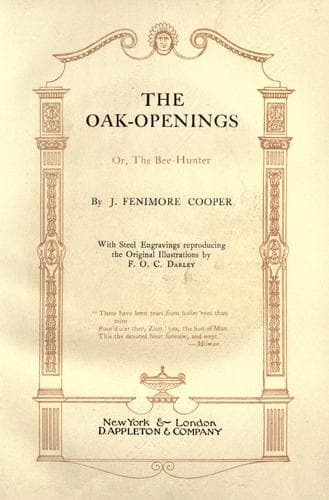
American fiction -- 19th century; Historical fiction; Indians of North America -- Fiction
Margery did as he desired. She was very familiar with the New Testament,
and, turning to the well-known and God-like passage, she read several
verses, in a steady, earnest voice. Perhaps the danger they were in,
and the recent communication of the death of their late companions,
increased her earnestness and solemnity of manner, for the effect
produced on Peter was scarcely less than that he had felt when he
witnessed a practical obedience to these sublime principles, in the
death of the missionary. Tears actually started to this stern savage's
eyes, and he looked back on his late projects and endeavors to immolate
a whole race with a shudder. Taking Margery's hand, he courteously
thanked her, and prepared to quit the place. Previously to leaving
his friends, however, Peter gave a brief account of the manner of the
missionary's death, and of the state in which he had left the corporal.
Pigeonswing had told him of the fate of the last, as well as of the
eagerness with which the band had set out in quest of more white scalps.
“Peter, we can count on you for a friend, I hope?” said the bee-hunter,
as the two were about to part, on the bank of the river. “I fear you
were, once, our enemy!”
“Bourdon,” said Peter, with dignity, and speaking in the language of his
own people, “listen. There are Good Spirits, and there are Bad Spirits.
Our traditions tell us this. Our own minds tell us this, too. For twenty
winters a Bad Spirit has been whispering in my ear. I listened to
him; and did what he told me to do. I believed what he said. His words
were--'Kill your enemies--scalp all the pale-faces--do not leave a
squaw, or a pappoose. Make all their hearts heavy. This is what an Injin
should do.' So has the Bad Spirit been whispering to me, for twenty
winters. I listened to him. What he said, I did. It was pleasant to me
to take the scalps of the pale-faces. It was pleasant to think that no
more scalps would be left among them, to take. I was Scalping Peter.
“Bourdon, the Good Spirit has, at last, made himself heard. His whisper
is so low, that at first my ears did not hear him. They hear him now.
When he spoke loudest, it was with the tongue of the medicine-priest of
your people. He was about to die. When we are about to die, our voices
become strong and clear. So do our eyes. We see what is before, and we
see what is behind. We feel joy for what is before--we feel sorrow for
what is behind. Your medicine-priest spoke well. It sounded in my ears
as if the Great Spirit, himself, was talking. They say it was his Son.
I believe them. Blossom has read to me out of the good book of your
people, and I find it is so. I feel like a child, and could sit down, in
my wigwam, and weep.
Public-domain text, read in full here on John Shaqi.
Reviews
Reviews
No reviews yet
Be the first to share your thoughts on this work.
Elsewhere in the archive
Join the Discussion
Join the discussion
Sign in to leave a comment or review.
Sign InorCreate an account