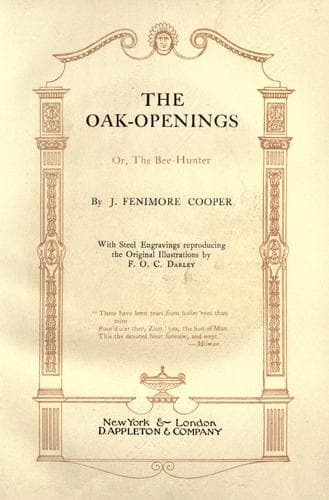
American fiction -- 19th century; Historical fiction; Indians of North America -- Fiction
All this was true, as far as it went, although the omissions were very
material. No one seemed to suspect the great chief, whose fidelity
to his own principles was believed to be of a character amounting to
enthusiasm. Little did any there know of the power of the unseen Spirit
of God to alter the heart, producing what religionists term the new
birth. We do not wish, however, to be understood that Peter had, as
yet, fully experienced this vast change. It is not often the work of a
moment, though well-authenticated modern instances do exist, in which we
have every reason to believe that men have been made to see and feel
the truth almost as miraculously as was St. Paul himself. As for this
extraordinary savage, he had entered into the strait and narrow way,
though he was not far advanced on its difficult path.
When men tell us of the great progress that the race is making toward
perfection, and point to the acts which denote its wisdom, its power to
control its own affairs, its tendencies toward good when most left
to its own self-control, our minds are filled with scepticism. The
every-day experience of a life now fast verging toward threescore,
contradicts the theory and the facts. We believe not in the possibility
of man's becoming even a strictly rational being, unaided by a power
from on high; and all that we have seen and read goes to convince us
that HE is most of a philosopher, the most accurate judge of his real
state, the most truly learned, who most vividly sees the necessity of
falling back on the precepts of revelation for all his higher principles
and practice. We conceive that this mighty truth furnishes unanswerable
proof of the unceasing agency of a Providence, and when we once admit
this, we concede that our own powers are insufficient for our own wants.
That the world, as a whole, is advancing toward a better state of
things, we as firmly believe as we do that it is by ways that have not
been foreseen by man; and that, whenever the last has been made the
agent of producing portions of this improvement, it has oftener been
without design, or calculation, than with it. Who, for instance,
supposes that the institutions of this country, of which we boast so
much, could have stood as long as they have, without the conservative
principles that are to be found in the Union; and who is there so vain
as to ascribe the overshadowing influence of this last great power to
any wisdom in man? We all know that perfectly fortuitous circumstances,
or what appear to us to be such, produced the Federal Government, and
that its strongest and least exceptionable features are precisely those
which could not be withstood, much less invented, as parts of the theory
of a polity.
Public-domain text, read in full here on John Shaqi.
Reviews
Reviews
No reviews yet
Be the first to share your thoughts on this work.
Elsewhere in the archive
Join the Discussion
Join the discussion
Sign in to leave a comment or review.
Sign InorCreate an account