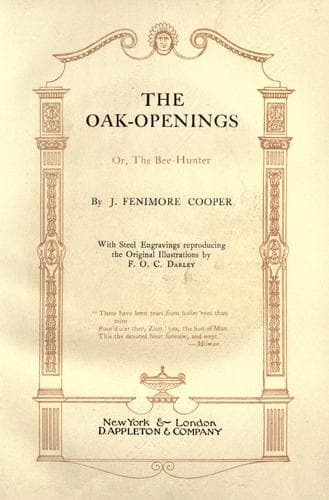
American fiction -- 19th century; Historical fiction; Indians of North America -- Fiction
It can easily be understood that the party with the canoes were left by
Peter in a state of great anxiety. The distance between the site of the
hut and their place of concealment was but little more than a quarter
of a mile, and the yell of the savages had often reached their ears,
notwithstanding the cover of the woods. This proximity, of itself, was
fearful; but the uncertainty that le Bourdon felt on the subject of
Peter's real intentions added greatly to his causes of concern. Of
course, he knew but little of the sudden change that had come over this
mysterious chief's feelings; nor is it very likely that he would have
been able to appreciate it, even had the fact been more fully stated.
Our hero had very little acquaintance with the dogmas of Christianity,
and would have, most probably, deemed it impossible that so great a
revolution of purpose could have been so suddenly wrought in the mind of
man, had the true state of the case been communicated to him. He would
have been ready enough to allow that, with God, nothing is impossible;
but might have been disposed to deny the influence of His Holy Spirit,
as exhibited in this particular form, for a reason no better than the
circumstance that he himself had never been the subject of such a power.
All that Peter had said, therefore, served rather to mystify him, than
to explain, in its true colors, what had actually occurred. With Margery
it was different. Her schooling had been far better than that of any
other of the party, and, while she admired the manly appearance, and
loved the free, generous character of her husband, she had more than
once felt pained at the passing thoughts of his great indifference to
sacred things. This feeling in le Bourdon, however, was passive rather
than active, and gave her a kind interest in his future welfare, rather
than any present pain through acts and words.
But, as respects their confidence in Peter, this young couple were much
farther apart than in their religious notions. The bee-hunter had never
been without distrust, though his apprehensions had been occasionally
so far quieted as to leave him nearly free of them altogether; while
his wife had felt the utmost confidence in the chief, from the very
commencement of their acquaintance. It would be useless, perhaps, to
attempt to speculate on the causes; but it is certain that there are
secret sources of sympathy that draw particular individuals toward each
other and antipathies that keep them widely separated. Men shall meet
for the first time, and feel themselves attracted toward each other,
like two drops of water, or repelled, like the corks of an electric
machine.
Public-domain text, read in full here on John Shaqi.
Reviews
Reviews
No reviews yet
Be the first to share your thoughts on this work.
Elsewhere in the archive
Join the Discussion
Join the discussion
Sign in to leave a comment or review.
Sign InorCreate an account