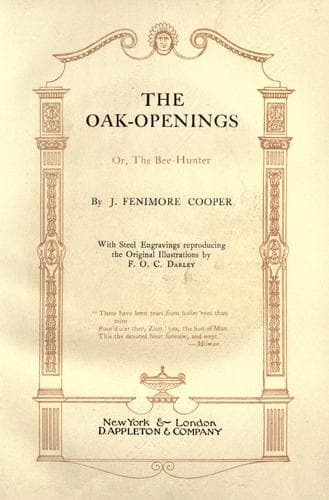
American fiction -- 19th century; Historical fiction; Indians of North America -- Fiction
“You are welcome, Chippewa,” cried le Bourdon, shaking his friend
cordially by the hand. “We were half afraid we might never see you
again. Do you bring us good or evil tidings?”
“Mustn't be squaw, and ask too much question, Bourdon,” returned the
red-skin, carefully examining the priming of his rifle, in order to make
sure it was not wet. “Got plenty venison, eh?”
“Not much venison is left, but we have caught a good many fish, which
have helped us along. I have killed a dozen large squirrels, too, with
your bow and arrows, which I find you left in your canoe. But--”
“Yes, he good bow, dat--might kill hummin'-bird wid dat bow. Fish good
here, eh?”
“They are eatable, when a body can get no better. But NOW, I should
think, Pigeonswing, you might give us some of the news.”
“Mustn't be squaw, Bourdon--bad for warrior be squaw. Alway bess be man,
and be patient, like man. What you t'ink, Bourdon? Got him at last!”
“Got WHAT my good fellow? I see nothing about you, but your arms and
ammunition.”
“Got scalp of dat Weasel! Wasn't dat well done? Nebber no young warrior
take more scalp home dan Pigeonswing carry dis time! Got t'ree; all
hid, where Bear's Meat nebber know. Take 'em away, when he get ready to
march.”
“Well, well, Chippewa--I suppose it will not be easy to reason you out
of this feelin'--but what has become of the red-skins who burned my
cabin, and who killed the missionary and the corporal?”
“All about--dough must go down river. Look here, Bourdon, some of dem
chief fool enough to t'ink bee carry you off on his wing!”
Here the Chippewa looked his contempt for the credulity and ignorance of
the others, though he did not express it after the boisterous manner in
which a white man of his class might have indulged. To him le Bourdon
was a good fellow, but no conjuror, and he understood the taking of the
bee too well to have any doubts as to the character of that process.
His friend had let him amuse himself by the hour in looking through his
spy-glass, so that the mind of this one savage was particularly well
fortified against the inroads of the weaknesses that had invaded those
of most of the members of the great council. Consequently, he was amused
with the notion taken up by some of the others, that le Bourdon had
been carried off by bees, though he manifested his amusement in a very
Indian-like fashion.
“So much the better,” answered le Bourdon; “and I hope they have
followed to line me down to my hive in the settlements.”
“Most on 'em go--yes, dat true. But some don't go. Plenty of Injins
still about dis part of Opening.”
“What are we then to do? We shall soon be in want of food. The fish do
not bite as they did, and I have killed all the squirrels I can find.
You know I dare not use a rifle.”
Public-domain text, read in full here on John Shaqi.
Reviews
Reviews
No reviews yet
Be the first to share your thoughts on this work.
Elsewhere in the archive
Join the Discussion
Join the discussion
Sign in to leave a comment or review.
Sign InorCreate an account