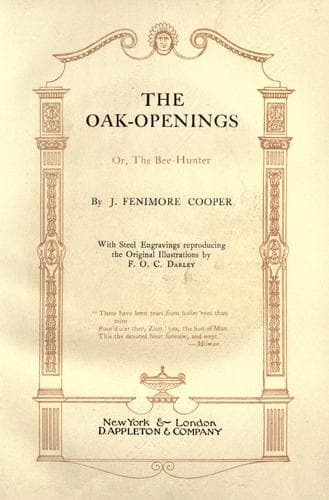
American fiction -- 19th century; Historical fiction; Indians of North America -- Fiction
“Nebber know Injin do dat,” said Peter, in a slow, deliberative sort of
way; “no, nebber know Injin do so. Always curse and hate his enemy, and
most when about to lose his scalp. Den, feelin's hottest. Den, most want
to use tomahawk on his enemy. Den, most feel dat he hate him. But not so
wid medicine-priest. Pray for Injin; ask Great Spirit to do him all
'e good he can; juss as Injin was goin' to strike. Won'erful--most
won'erful DAT, in my eyes. Blossom, you know Peter. He your fader. He
take you, and make you his da'ghter. His heart is soft to you, Blossom.
But, he nuttin' but poor Injin, dough a great chief. What he know?
Pale-face pappoose know more dan Injin chief. Dat come from Great Spirit
too. He wanted it so, and it is so. Our chiefs say dat Great Spirit love
Injin. May be so. T'ink he love ebbery body; but he can't love Injin as
much as he love pale-face, or he wouldn't let red man know so little.
Don't count wigwams, and canoes, and powder, and lead, as proof of Great
Spirit's love. Pale-face got more of dese dan Injin. Dat I see and know,
and dat I feel. But it no matter. Injin used to be poor, and don't care.
When used to be poor, den used to it. When used to be rich, den it hard
not to be rich. All use. Injin don't care. But it bad not to know. I'm
warrior--I'm hunter--I'm great chief. You squaw--you young--you know
so much as squaw of chief. But you know most. I feel ashamed to know so
little. Want to know more. Want to know most how 'e Son of Great Spirit
die for all tribe, and pray to his fader to bless 'em dat kill him. Dat
what Peter now want most to know!”
“I wish I was better able to teach you, Peter, from the bottom of my
heart; but the little I do know you shall hear. I would not deny you for
a thousand worlds, for I believe the Holy Spirit has touched your heart,
and that you will become a new man. Christians believe that all must
become new men, who are to live in the other world, in the presence of
God.”
“How can dat be? Peter soon be ole--how can ole man grow young ag'in?”
“The meaning of this is that we must so change in feelings, as no longer
to be the same persons. The things that we loved we must hate, and the
things that we hated, or at least neglected, we must love. When we feel
this change in our hearts, then may we hope that we love and reverence
the Great Spirit, and are living under his holy care.”
Peter listened with the attention of an obedient and respectful child.
If meekness, humility, a wish to learn the truth, and a devout sentiment
toward the Creator, are so many indications of the “new birth,” then
might this savage be said to have been truly “born again.” Certainly he
was no longer the same man, in a moral point of view, and of this he was
himself entirely conscious. To him the wonder was what had produced so
great and so sudden a change! But the reply he made to Margery will, of
itself, sufficiently express his views of his own case.
Public-domain text, read in full here on John Shaqi.
Reviews
Reviews
No reviews yet
Be the first to share your thoughts on this work.
Elsewhere in the archive
Join the Discussion
Join the discussion
Sign in to leave a comment or review.
Sign InorCreate an account