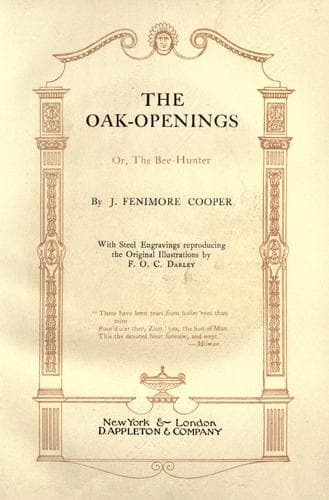
American fiction -- 19th century; Historical fiction; Indians of North America -- Fiction
One very important fact was ascertained by le Bourdon, as soon as these
arrangements were explained and completed. The wind on the lake was
blowing from the south, and of course was favorable to those who desired
to proceed in the opposite direction. This he communicated to Margery in
a low tone, endeavoring to encourage her by all the means in his power.
In return, the young wife muttered a few encouraging words to her
husband. Every measure was understood between the parties. In the event
of a discovery, the canoes were to bury themselves in the rice, taking
different directions, each man acting for himself. A place of rendezvous
was appointed outside, at a headland known to Gershom and le Bourdon,
and signals were agreed on, by which the latest arrival might know that
all was safe there. These points were settled as the canoes floated
slowly down the stream.
Peter took and kept the lead. The night was star-lit and clear, but
there was no moon. On the water, this made but little difference,
objects not being visible at any material distance. The chief governed
the speed, which was moderate, but regular. At the rate he was now
going, it would require about an hour to carry the canoes into the lake.
But nearly all of that hour must pass in the midst of enemies!
Half of the period just mentioned elapsed, positively without an alarm
of any sort. By this time, the party was abreast of the spot where
Gershom and le Bourdon had secreted the canoes in the former adventure
at the mouth of the river. On the shores, however, a very different
scene now offered. Then, the fire burned brightly in the hut, and the
savages could be seen by its light. Now, all was not only dark, but
still as death. There was no longer any cry, sound, alarm, or foot-fall,
audible. The very air seemed charged with uncertainty, and its
offspring, apprehension.
As they approached nearer and nearer to what was conceived to be the
most critical point in the passage, the canoes got closer together; so
close, indeed, that le Bourdon and Gershom might communicate in very
guarded tones. The utmost care was taken to avoid making any noise,
since a light and careless blow from a paddle, on the side of a canoe,
would be almost certain, now, to betray them. Margery and Dorothy could
no longer control their feelings, and each rose in her seat, raising her
body so as to bring her head above the gunwale of the canoe, if a bark
canoe can be said to have a gunwale at all. They even whispered to each
other, endeavoring to glean encouragement by sympathy. At this instant
occurred the crisis in their attempt to escape.
CHAPTER XXIX.
For an Indian isle she shapes her way
With constant mind both night and day:
She seems to hold her home in view
And sails as if the path she knew,
So calm and stately in her motion
Across the unfathomed, trackless ocean.
-- WILSON.
Public-domain text, read in full here on John Shaqi.
Reviews
Reviews
No reviews yet
Be the first to share your thoughts on this work.
Elsewhere in the archive
Join the Discussion
Join the discussion
Sign in to leave a comment or review.
Sign InorCreate an account