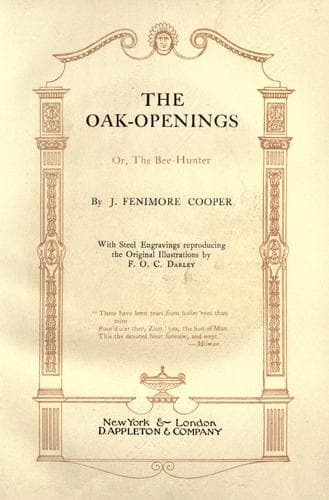
American fiction -- 19th century; Historical fiction; Indians of North America -- Fiction
In this manner several more hours were passed, and six times as many
more miles were made in distance. When le Bourdon again landed, which
he did shortly before the sun set, he calculated his distance from
the mouth of the Kalamazoo to be rather more than a hundred miles. His
principal object was to ascend a bluff and to take a look at the coast,
in order to examine it for canoes. This his glass enabled him to do with
some accuracy, and when he rejoined the party, he was rejoiced to have
it in his power to report that the coast was clear. After refreshing
themselves, the canoes were again brought together, in order to divide
the watches, and a new start was made for the night. In this manner did
our adventurers make their way to the northward for two nights and days,
landing often, to fish, hunt, rest, and cook, as well as to examine the
coast. At the end of the time mentioned, the celebrated straits of the
Michillimackinac, or Mackinaw, as they are almost universally termed,
came in sight. The course had been gradually changing toward the
eastward, and, luckily for the progress of the fugitives, the wind with
it, leaving them always a favorable breeze. But it was felt to be no
longer safe to use a sail, and recourse was had to the paddles, until
the straits and island were passed. This caused some delay, and added a
good deal to the labor; but it was deemed so dangerous to display
their white cotton sails, objects that might be seen for a considerable
distance, that it was thought preferable to adopt this caution. Nor
was it useless. In consequence of this foresight, a fleet of canoes was
passed in safety, which were crossing from the post at Mackinaw to ward
the main land of Michigan. The number of the canoes in this fleet could
not have been less than fifty, but getting a timely view of them, le
Bourdon hid his own craft in a cove, and remained there until the danger
was over.
The course now changed still more, while the wind got quite round to the
westward. This made a fair wind at first, and gave the canoes a good lee
as they advanced. Lake Huron, which was the water the fugitives were now
on, lies nearly parallel to Michigan, and the course was southeasterly.
As le Bourdon had often passed both ways on these waters, he had his
favorite harbors, and knew those signs which teach navigators how to
make their prognostics of the weather. On the whole, the fugitives did
very well, though they lost two days between Mackinaw and Saginaw Bay;
one on account of the strength of the wind, and one on account of rain.
During the last, they remained in a hut that le Bourdon had himself
constructed in one of his many voyages, and which he had left standing.
These empty cabins, or chientes, are of frequent occurrence in new
countries, being used, like the Refuges in the Alps, by every traveller
as he has need of them.
Public-domain text, read in full here on John Shaqi.
Reviews
Reviews
No reviews yet
Be the first to share your thoughts on this work.
Elsewhere in the archive
Join the Discussion
Join the discussion
Sign in to leave a comment or review.
Sign InorCreate an account