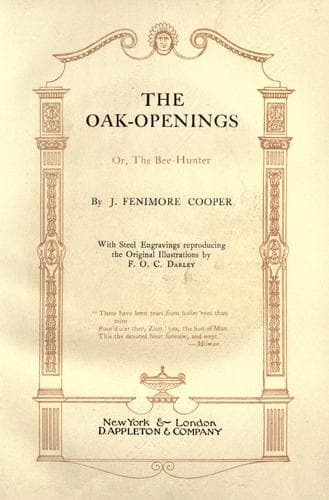
American fiction -- 19th century; Historical fiction; Indians of North America -- Fiction
As the cheek of the charming girl flushed with excitement, and her race
became animated, Margery appeared marvellously handsome; more so, the
bee-hunter fancied, than any other female he had ever before seen. But
her words impressed him quite as much as her looks; for he at once saw
the importance of such an event, to persons in their situation. The
wind was rising on the lake, and it was ahead for the canoes; should the
savages feel the necessity of making a harbor, they might return to the
mouth of the Kalamazoo; a step that would endanger all their lives, in
the event of these Indians proving to belong to those, whom there
was now reason to believe were in British pay. In times of peace, the
intercourse between the whites and the red men was usually amicable,
and seldom led to violence, unless through the effects of liquor; but, a
price being placed on scalps, a very different state of things might be
anticipated, as a consequence of the hostilities. This was then a matter
to be looked to; and, as evening was approaching, no time was to be
lost.
The shores of Michigan are generally low, nor are harbors either
numerous, or very easy of access. It would be difficult, indeed, to
find in any other part of the world, so great an extent of coast that
possesses so little protection for the navigator, as that of this very
lake. There are a good many rivers, it is true, but usually they have
bars, and are not easy of entrance. This is the reason why that very
convenient glove, the Constitution, which can be made to fit any hand,
has been discovered to have an extra finger in it, which points out a
mode by which the federal government can create ports wherever nature
has forgotten to perform this beneficent office. It is a little
extraordinary that the fingers of so many of the great “expounders” turn
out to be “thumbs,” however, exhibiting clumsiness, rather than that
adroit lightness which usually characterizes the dexterity of men who
are in the habit of rummaging other people's pockets, for their own
especial purposes. It must be somewhat up-hill work to persuade any
disinterested and clear-headed man, that a political power to “regulate
commerce” goes the length of making harbors; the one being in a great
measure a moral, while the other is exclusively a physical agency; any
more than it goes the length of making ware-houses, and cranes, and
carts, and all the other physical implements for carrying on trade. Now,
what renders all this “thumbing” of the Constitution so much the more
absurd, is the fact, that the very generous compact interested does
furnish a means, by which the poverty of ports on the great lakes may
be remedied, without making any more unnecessary rents in the great
national glove. Congress clearly possesses the power to create and
maintain a navy, which includes the power to create all sorts of
necessary physical appliances; and, among others, places of refuge for
that navy, should they be actually needed.
Public-domain text, read in full here on John Shaqi.
Reviews
Reviews
No reviews yet
Be the first to share your thoughts on this work.
Join the Discussion
Join the discussion
Sign in to leave a comment or review.
Sign InorCreate an account