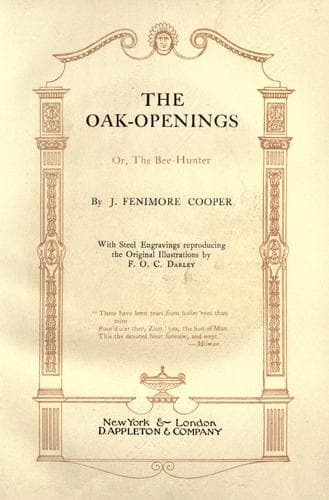
American fiction -- 19th century; Historical fiction; Indians of North America -- Fiction
At the next moment the feet of the Chippewa were released, as were also
his knees. Of all the fastenings none now remained but that which bound
the captive to the tree. In not cutting this, the bee-hunter manifested
his coolness and judgment; for were the stout rope of bark severed, the
Indian would have fallen like a log, from total inability to stand. His
thongs had impeded the circulation of the blood, and the usual temporary
paralysis had been the consequence. Pigeonswing understood the reason
of his friend's forbearance, and managed to rub his hands and wrists
together, while the bee-hunter himself applied friction to his feet,
by passing his own arms around the bottom of the tree. The reader may
imagine the intense anxiety of Margery the while; for she witnessed the
arrival of le Bourdon at the tree, and could not account for the long
delay which succeeded.
All this time, the dogs were far from being quiet or satisfied. Their
masters, accustomed to being surrounded at night by wolves and foxes,
or other beasts, took little heed, however, of the discontent of these
creatures, which were in the habit of growling in their lairs. The
bee-hunter, as he kept rubbing at his friend's legs, felt now but little
apprehension of the dogs, though a new source of alarm presented itself
by the time the Chippewa was barely able to sustain his weight on his
feet, and long before he could use them with anything like his former
agility. The manner in which the savages came together in the hut, and
the gestures made by their chief, announced pretty plainly that a watch
was about to be set for the night. As it was probable that the sentinel
would take his station near the prisoner, the bee-hunter was at a loss
to decide whether it were better to commence the flight before or after
the rest of the savages were in their lairs. Placing his mouth as close
to the ear of Pigeonswing as could be done without bringing his head
into the light, the following dialogue passed between le Bourdon and the
captive.
“Do you see, Chippewa,” the bee-hunter commenced, “the chief is telling
one of the young men to come and keep guard near you?”
“See him, well 'nough. Make too many sign, no to see.”
“What think you--shall we wait till the warriors are asleep, or try to
be off before the sentinel comes?”
“Bess wait, if one t'ing. You got rifle--got tomahawk--got knife, eh?”
“I have them all, though my rifle is a short distance behind me, and a
little down the hill.”
“Dat bad--nebber let go rifle on war-path. Well, YOU tomahawk him--_I_
scalp him--dat'll do.”
“I shall kill no man, Chippewa, unless there is great occasion for it.
If there is no other mode of getting you off, I shall choose to cut this
last thong, and leave you to take care of yourself.”
“Give him tomahawk, den--give him knife, too.”
“Not for such a purpose. I do not like to shed blood without a good
reason for it.”
Public-domain text, read in full here on John Shaqi.
Reviews
Reviews
No reviews yet
Be the first to share your thoughts on this work.
Elsewhere in the archive
Join the Discussion
Join the discussion
Sign in to leave a comment or review.
Sign InorCreate an account