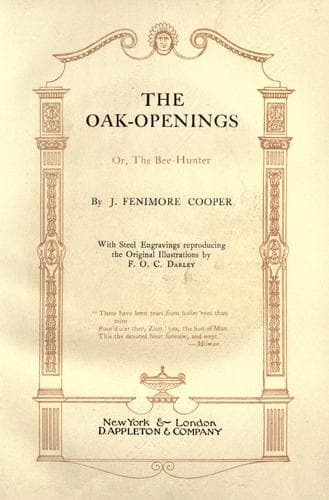
American fiction -- 19th century; Historical fiction; Indians of North America -- Fiction
The great advantage that the party of the bee-hunter had now obtained
must be very apparent to all. In possession of ALL the canoes, their
enemies were, or would be for some time at least, confined to the
northern side of the river, which was so wide near its mouth as to
present an effectual barrier between them and those who occupied the
opposite bank. The canoes, also, enabled the weaker party to change
their position at will, carrying with them as many effects as were on
board, and which included the whole of the property of le Bourdon; while
their loss deprived their enemies of all extra means of motion, and
would be very likely to induce them to proceed on their expedition by
land. The objects of that expedition could only be conjectured by the
bee-hunter, until he had questioned the Chippewa; a thing he did not
fail to do, so soon as he believed the party quite safe under the south
shore. Here the fugitives landed, proceeding up a natural channel in the
wild rice in order to do so, and selecting a bit of dry beach for
their purpose. Margery set about lighting a fire, in order to keep the
mosquitos at a distance, selecting a spot to kindle it, behind a swell
on the land, that concealed the light from all on the other shore. In
the morning, it would be necessary to extinguish that fire, lest its
smoke should betray their position. It was while these things were in
progress, and after le Bourdon had himself procured the fuel necessary
to feed pretty Margery's fire, that he questioned the Chippewa touching
his captivity.
“Yes, tell all 'bout him,” answered the Indian, as soon as
interrogated--“no good to hide trail from friend. 'Member when say
good-by up in openin' to Bourdon?”
“Certainly--I remember the very instant when you left me. The
Pottawattamie went on one path, and you went on another. I was glad of
that, as you seemed to think he was not your friend.”
“Yes; good not to travel on same path as inimy, 'cause he quarrel
sometime,” coolly returned the Indian. “Dis time, path come together,
somehow; and Pottawattamie lose he scalp.”
“I am aware of all that, Pigeonswing, and wish it had not been so. I
found the body of Elksfoot sitting up against a tree soon after you left
me, and knew by whose hands he had fallen.”
“Didn't find scalp, eh?”
“No, the scalp had been taken; though I accounted that but for little,
since the man's life was gone. There is little gained by carrying on war
in this manner, making the woods, and the openings, and the prairies,
alike unsafe. You see, to what distress this family is reduced by your
Injin manner of making war.”
“How you make him, den--want, to hear. Go kiss, and give venison to
inimy, or go get his scalp, eh? Which bess fashion to make him afeard,
and own you master?”
“All that may be done without killing single travellers, or murdering
women and children. The peace will be made none the sooner between
England and America, because you have got the scalp of Elksfoot.”
Public-domain text, read in full here on John Shaqi.
Reviews
Reviews
No reviews yet
Be the first to share your thoughts on this work.
Elsewhere in the archive
Join the Discussion
Join the discussion
Sign in to leave a comment or review.
Sign InorCreate an account