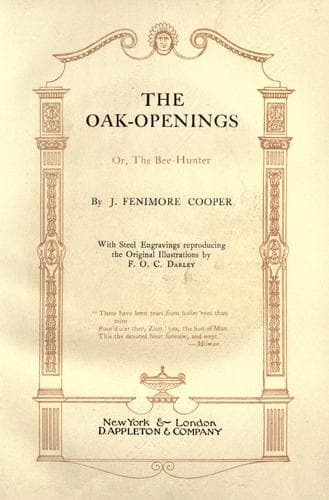
American fiction -- 19th century; Historical fiction; Indians of North America -- Fiction
An hour had intervened between the time when le Bourdon had removed the
canoes of the Pottawattamies, and the time when he returned alone to the
northern side of the river. In the course of that hour the chief of the
savages had time to ascertain all the leading circumstances that have
just been related, and to collect his people in and around the hut, for
a passing council. The moment was one of action, and not of ceremonies.
No pipe was smoked, nor any of the observances of the great councils
of the tribe attended to; the object was merely to glean facts and
to collect opinions. In all the tribes of this part of North America,
something very like a principle of democracy is the predominant feature
of their politics. It is not, however, that bastard democracy which
is coming so much in fashion among ourselves, and which looks into the
gutters solely for the “people,” forgetting that the landlord has just
as much right to protection as the tenant, the master as the servant,
the rich as the poor, the gentleman as the blackguard. The Indians
know better than all this. They understand, fully, that the chiefs are
entitled to more respect than the loafers in their villages, and listen
to the former, while their ears are shut to the latter. They appear
to have a common sense, which teaches them to avoid equally the
exaggerations of those who believe in blood, and of those who believe
in blackguardism. With them the doctrines of “new men” would sound as
an absurdity, for they never submit to change for change's sake. On
the contrary, while there is no positive hereditary rank, there is much
hereditary consideration; and we doubt if a red man could be found
in all America, who is so much of a simpleton as to cite among the
qualifications of any man for a situation of trust and responsibility,
that he had never been TAUGHT how to perform its duties. They are
not guilty of the contradiction of elevating men BECAUSE they are
self-taught, while they expend millions on schools. Doubtless they
have, after a fashion of their own, demagogues and Caesars, but they are
usually kept within moderate limits; and in rare instances, indeed,
do either ever seriously trespass on the rights of the tribe. As human
nature is everywhere the same, it is not to be supposed that pure
justice prevails even among savages; but one thing would seem to be
certain, that, all over the world, man in his simplest and wildest state
is more apt to respect his own ordinances, than when living in what is
deemed a condition of high civilization.
Public-domain text, read in full here on John Shaqi.
Reviews
Reviews
No reviews yet
Be the first to share your thoughts on this work.
Elsewhere in the archive
Join the Discussion
Join the discussion
Sign in to leave a comment or review.
Sign InorCreate an account