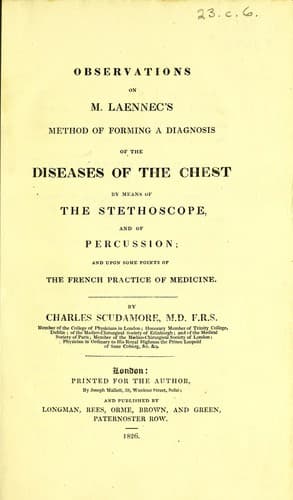
Observations on M. Laennec's method of forming a diagnosis of the diseases of the chest by means of the stethoscope, and of percussion; and upon some points of the French practice of medicineScudamore, Charles
Science
Observations on M. Laennec's method of forming a diagnosis of the diseases of the chest by means of the stethoscope, and of percussion; and upon some points of the French practice of medicine
Scudamore, Charles
Chest -- Diseases -- Diagnosis; Laennec, R. T. H. (René Théophile Hyacinthe), 1781-1826
The absence of the respiratory sound may arise from an impermeable
state of the cells, or the bronchial ramifications, and have for its
cause the presence of tubercles, or other matter of obstruction;
or it may proceed from some secretion or effusion, the produce of
disease. But the student, when he does not discover any sound of
respiration, must be careful to avoid drawing false conclusions from
his yet imperfect tact in the art; it so commonly happens, that
calm respiration does not afford any distinct perceptions to the
unpractised ear.
It appears to me worthy of consideration, whether or not, in some
states of hydrothorax, the evacuation of the fluid by puncture may be
a desirable expedient? The increased accuracy of diagnosis attainable
by means of the stethoscope, would here be very important towards
deciding the fit period for the performance of the operation.
In the narration of my cases, I have not made mention of percussion.
Suffice it to observe, that I have seldom used it except in chronic
diseases of the chest, as the indications by the stethoscope,
in addition to the general symptoms, have afforded me all the
information which I have required.
I shall here bring my Observations to a conclusion, having
endeavoured to present in a concise and intelligible form, a part of
the results of my own experience in the use of the stethoscope; and
to consider briefly the merit of some points of practice; inquiring
at the same time into the nature of several medicines, which
claim our particular attention, both from their novelty and their
importance.
The value of any practical opinion must be decided by the suffrages
of the many; but, whoever collects and records his facts with care
and fidelity, renders some contribution to the advancement of the
medical art.
FINIS.
MALLETT, PRINTER, WARDOUR STREET.
FOOTNOTES:
[1] I am inclined to think, that during the inflammatory diathesis,
a larger proportion of fibrin than natural is actually formed in
the assimilating process; and it is further probable that it is not
distributed as usual to the several fibrous textures of the body. In
my Essay on the Blood, I have suggested this last hypothesis.
[2] See Forbes’s Translation, p. 19.
[3] In 1822, M. J. A. Legumeau de Kergarader published a Memoir
“Sur l’Auscultation,” &c. in reference to gestation; and in 1824,
M. J. Lisfranc, a Memoir, to show the powers of the stethoscope in
enabling the surgeon to detect with greater nicety the fractures of
bones. I have read these essays, which must be allowed the praise of
ingenuity; and I conceive that cases may occur of each description,
in which the aid of the stethoscope would be found not unimportant.
Public-domain text, read in full here on John Shaqi.
Reviews
Reviews
No reviews yet
Be the first to share your thoughts on this work.
Join the Discussion
Join the discussion
Sign in to leave a comment or review.
Sign InorCreate an account