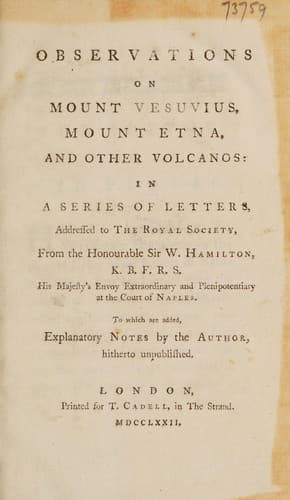
Observations on Mount Vesuvius, Mount Etna, and Other VolcanosHamilton, William, Sir
Science
Observations on Mount Vesuvius, Mount Etna, and Other Volcanos
Hamilton, William, Sir
Etna, Mount (Italy) -- Early works to 1800; Vesuvius (Italy) -- Early works to 1800; Volcanoes -- Italy -- Early works to 1800
25. The Solfaterra, anciently called Forum Vulcani: between the
Solfaterra and the lake of Agnano, are the boiling waters of
the Pisciarelli.
26. The New Mountain, formed by explosion in the year 1538; the
sand of the sea shore at its basis burning hot.
27. The lake of Agnano, supposed the crater of an ancient Volcano:
here are the baths called St. Germano, and the famous Grotto
del Cane.
28. Astruni, which has been evidently a Volcano, and is now a
Royal Chace, the crater being surrounded with a wall.
29. The Monte Gauro or Barbaro, anciently a Volcano.
30. The lake of Avernus, evidently the crater of an ancient
Volcano.
31. Lake of Fusaro.
32. Point of Misenum, from whence Pliny the elder discovered the
eruption of Vesuvius that proved fatal to him; near this
place, in a vault of an ancient building, is a constant
vapour, or _mofete_, of the same quality with that of the
Grotto del Cane.
33. The Mare Morto, the ancient Roman Harbour.
34. Baia; behind the castle are two evident craters of ancient
Volcanos.
35. Island of Procita.
36. A perfect cone and crater of a Volcano near Castiglione in the
island of Ischia.
37. Lava that ran into the sea in the last eruption on this
island, in the year 1301, or 1302: the place now called Le
Cremate.
38. Town of Ischia and castle.
39. Lake of Licola.
40. Lake of Patria.
41. The river Volturnus.
42. Capua.
43. Caserta.
44. Aversa.
45. Mataloni.
46. Acerra.
47. Island of Ischia, anciently called AEnaria, Inarime, and
Pithecusa.
48. The mountain of St. Nicola, anciently called Mons Epomeus,
supposed the remains of the principal Volcano of the island.
49. Castiglione, near which are the baths of Gurgitelli.
50. Lacco, near which is that very cold vapour called by the
natives _ventarole_.
51. Ancient city of Pompeii, where his Sicilian Majesty's
excavations are carrying on at present.
52. Rovigliano.
53. River of Sarno.
54. Cuma.
55. Hot sands and sudatory, called Nero's baths.
56. The Lucrine lake, supposed to have been here, and of which
there is still some little remain.
57. Villa Angelica, Sir William Hamilton's villa, from whence he
has made many of his observations upon Mount Vesuvius.
58. Cones formed by an ancient eruption called _viuli_; here are
likewise cold vapours called _ventaroli_.
59. High grounds, probably sections of cones of ancient Volcanos,
being all composed of _tufa_ and strata of loose pumice and
burnt matter.
60. Plain of the Campagna Felice, four or five feet of excellent
soil, under which are strata of burnt and erupted matter.
...... Marks the boundary of Sir William Hamilton's observations.
LETTER VI.[45]
To MATHEW MATY, M. D. Secretary to the Royal SOCIETY.
Naples, March 5, 1771.
Public-domain text, read in full here on John Shaqi.
Reviews
Reviews
No reviews yet
Be the first to share your thoughts on this work.
Join the Discussion
Join the discussion
Sign in to leave a comment or review.
Sign InorCreate an account