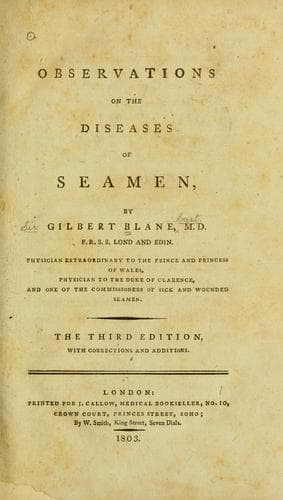
Observations on the Diseases of SeamenBlane, Gilbert, Sir
History
Observations on the Diseases of Seamen
Blane, Gilbert, Sir
Medicine, Naval -- Early Works To 1800; Sailors -- Diseases
Spring water is to be preferred to running or stagnated water; for,
unless it is taken at the source, or near it, it is apt to be
impregnated with decayed vegetable and animal substances, such as
leaves, grass, wood, and dead insects. This inconvenience is greatest
in a hot climate, where every thing teems with life, and where the
materials of putrefaction are both more abundant and more prone to
corruption. This is the most pernicious kind of impurity; for the
mineral impregnations common in springs are seldom, in any degree,
unwholesome, and do not tend, like the other, to make the water
corrupt. At many of the West-India watering places the water is found
stagnated just above high-water mark; and care should be taken to go
higher up to take it where it is running.
The purest water is apt to spoil by producing a putrid glare upon
the inner surface of the cask which contains it. There is a great
difference in this respect between a new cask, especially if made of
moist wood, and that cask which has been hardened and seasoned by age
and use. Several contrivances have been proposed for preparing the
vessels that hold the water; but none have been found by experience so
effectual as letting them stand for some time full of sea water; and it
is a great advantage of this method, that it is so easily practicable.
It is in few places we meet with water such as that of Bristol,
which, in clean vessels, may be kept for any length of time. We may
consider all water kept in wooden vessels as more or less liable to
putrefaction; but there is a substance, which is neither rare nor
costly, that effectually preserves it sweet. This is _quick lime_,
with which every ship should be provided, in order to put a pint of it
into each butt when it is filled. It has the advantage of not being
injurious to health; but, on the contrary, is rather friendly to the
bowels, tending to prevent and check fluxes. In the year 1779 several
ships of the line arrived in the West Indies from England, and they
were all afflicted with the flux, except the Stirling Castle, which
was the only ship in which quick lime was put into the water. Nor does
it spoil the water for any culinary purpose. Its action in preventing
putrefaction consists, in part at least, in destroying vegetable and
animal life. An addition of putrescent matter is produced in water by
the generation of small insects; and the glare that collects on the
sides of casks, and also what collects on the surface of the water, is
a species of vegetation of the order called by naturalists _algæ_[79].
Quick lime is a poison to this species of vegetable life as well as to
insects: but upon whatever principle it depends, the property of it in
preserving water sweet is so well ascertained, that it is inexcusable
ever to neglect the use of it.
Public-domain text, read in full here on John Shaqi.
Reviews
Reviews
No reviews yet
Be the first to share your thoughts on this work.
Elsewhere in the archive
Join the Discussion
Join the discussion
Sign in to leave a comment or review.
Sign InorCreate an account