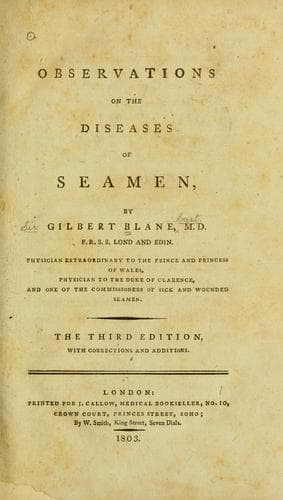
Observations on the Diseases of SeamenBlane, Gilbert, Sir
History
Observations on the Diseases of Seamen
Blane, Gilbert, Sir
Medicine, Naval -- Early Works To 1800; Sailors -- Diseases
The next means of relief I shall mention, and also the most probable
means of cutting short the disease, is to excite universal sweat.
This being an imitation of nature, is founded on reason as well as
experience; for it is by sweating that the fit of an intermittent
is relieved and terminated; and continued fevers in general, if not
always, begin with a fit of the same kind. A dry skin, accompanied
with heat, is one of the most constant as well as troublesome and
uneasy symptoms in all fevers; and it would appear from the peculiar
heat of the skin in this sort of fever, that there is either a more
than common acrimony of the matter of perspiration, or something
peculiar in the mode of circulation on the surface of the body.
Sweating does not seem to operate entirely by the evacuation of
acrimony, for no relief is procured by it if it is partial; and it
is evident from a number of facts that the state of the brain and
_viscera_ depends on that of the external surface of the body; for a
free state of the pores of the skin, provided it is general, tends more
than any other circumstance to relieve internal pain, and also to take
off delirium. The good effect of sweating seems, therefore, chiefly to
depend on a general relaxed state of the small vessels on the surface
of the body; and it ought to be effected, if possible, by gentle,
soothing means, and not by such regimen and medicines as heat the body
and accelerate the circulation. This intention is best answered in the
beginning by moderate doses of antimonial medicines, and either James’s
powder or tartar emetic may be employed. The first is a more certain
sudorific, being less apt than the other to run off by the bowels;
and its effect will be still more certain, if accompanied with a mild
opiate, rendered diaphoretic by _Spiritus Mindereri_, which will both
prevent the antimonial from acting roughly, and will determine its
operation to the skin. A sweat kept up by these means, together with
plentiful warm dilution, from twelve to twenty-four hours, is the most
probable means of bringing about a complete remission of the fever;
and in this case a fresh accession is to be prevented by the immediate
administration of the bark.
Public-domain text, read in full here on John Shaqi.
Reviews
Reviews
No reviews yet
Be the first to share your thoughts on this work.
Elsewhere in the archive
Join the Discussion
Join the discussion
Sign in to leave a comment or review.
Sign InorCreate an account