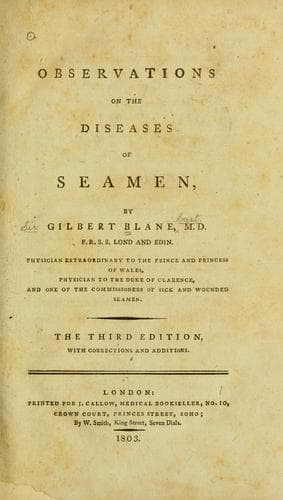
Observations on the Diseases of SeamenBlane, Gilbert, Sir
History
Observations on the Diseases of Seamen
Blane, Gilbert, Sir
Medicine, Naval -- Early Works To 1800; Sailors -- Diseases
In all stages of it an accurate discernment is necessary with regard
to the use of opiates, and great part of the practice here consists in
timing these well. They are least admissible in the beginning, where
evacuation is the principal object; but as the disease advances they
become more and more allowable and useful. The principal cautions
necessary in their administration are, 1. To premise sufficient
evacuation, so that the intestines may not be loaded with bile,
_scybala_, or any other irritating matter at the time of giving the
opiate. 2. To obviate the effects which an anodyne has of causing a
retention of the contents of the intestines. This may be done, either
by giving something purgative along with it, or after it has produced
its quieting effect. The former method seems preferable; for as soon as
the effect of the opiate is over, the purgative is ready to act; and
in this way it is so far favourable to the operation of the purgative
that large feculent stools will be discharged: whereas, had the
purgative been given alone, it would have been more apt to produce
scanty griping stools, attended with tenesmus. Rhubarb answers well in
such cases, and may be given in a dose from twelve to twenty grains,
according to the age and constitution. 3. To prevent feverish heat
and delirium. This was proposed to be done in the first stage of the
disease, by combining it with ipecacuana and a little neutral salt.
With the same intention, it may now be joined with a few grains of Dr.
James’s powder, or _vitrum ceratum antimonii_, in which form it would
not be so strongly sudorific, an effect not so much required in the
chronic as in the acute state.
The principal causes that keep up the flux, and render it so obstinate,
are, 1. A too great secretion of bile, either continual or frequently
recurring. 2. Ulcers in the great intestines. 3. A lienteric state of
the bowels. 4. A retention of _scybala_.
The first cause is much less frequent than might be expected by those
who fancy that every disease of this climate proceeds from bile.
When there does occur a redundancy of bile, there is more occasion
for the employment of evacuant medicines, and more need of caution
in that of opiates. A medicine that will dispose the liver, or the
circulating system in general, to form less bile, is a _desideratum_ in
physic; but, in case of an excessive flow of it, emetics and mercurial
purgatives, as has been already mentioned, are the best means of
evacuating it; and care should be taken that it be discharged before it
accumulates too much, or becomes acrid by too long retention.
Public-domain text, read in full here on John Shaqi.
Reviews
Reviews
No reviews yet
Be the first to share your thoughts on this work.
Elsewhere in the archive
Join the Discussion
Join the discussion
Sign in to leave a comment or review.
Sign InorCreate an account