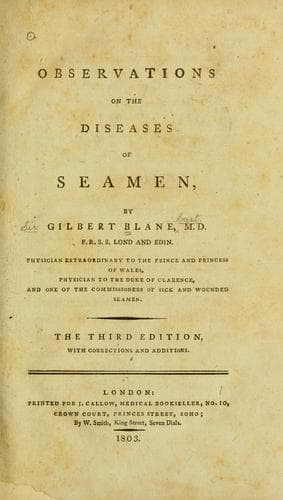
Observations on the Diseases of SeamenBlane, Gilbert, Sir
History
Observations on the Diseases of Seamen
Blane, Gilbert, Sir
Medicine, Naval -- Early Works To 1800; Sailors -- Diseases
We have a proof of this general languor not only from the great
aversion to motion, and the great disposition to syncope, but from
the inspection of the dead body, from which it appears that the
whole circulating system, being more flaccid and less elastic, is
subject to preternatural distention. The heart is accordingly found
enlarged in bulk, the size of the cavities being increased; and in
the extremities, where the circulation is naturally most languid,
the small vessels carrying the colourless part of the blood, are so
far enlarged as to admit the red part of it, as appears by the livid
colour; and where this is the case, these vessels being unable to
carry on the circulation, a stagnation ensues, as is evident in those
livid appearances most common about the calves of the leg, which feel
like a hard cake. I have examined those parts in the dead subject, and
found a want of fluidity in the contents of the vessels, but could not
discover any thing like _eechymosis_; from which I concluded that the
colour was owing to an _error loci_, and the hardness to stagnation and
coagulation of the fluids, and a want of action of the vessels.
The incurable state of ulcers, so common in this disease, is also
what we might expect from the defect of fresh assimilated juices; for
where a breach is made, either by nature or accident, in the solids,
particularly of the extremities, the proper suppuration is prevented by
the depraved state both of the fluids and vessels; and we cannot expect
that renewal of solid parts in which healing consists, where both the
instruments and materials of its formation are so defective.
I shall conclude what I have to say on this subject, by shortly
considering whether or not this disease is ever contagious.
There is something in the nature and history of the scurvy that
would lead us at once to pronounce that it is not infectious; for
the external causes on which it depends are so obvious, and seem so
adequate to account for its appearance and prevalence upon certain
occasions, as at first sight to exclude every other external cause.
But it seems extremely unphilosophical to deny the reality or
possibility of any thing in Nature, from our supposed knowledge of the
means and causes she employs, particularly in a branch of science so
obscure as the animal œconomy. Could we, therefore, prove the point
as a matter of fact, it would be in vain to deny it, from our fancied
acquaintance with Nature’s modes of operation.
Public-domain text, read in full here on John Shaqi.
Reviews
Reviews
No reviews yet
Be the first to share your thoughts on this work.
Elsewhere in the archive
Join the Discussion
Join the discussion
Sign in to leave a comment or review.
Sign InorCreate an account