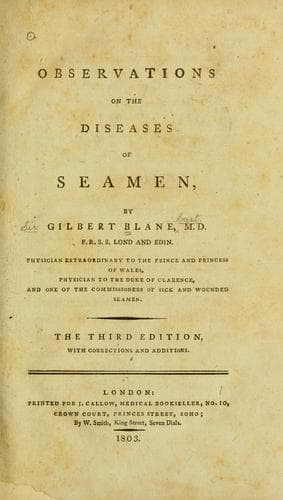
Observations on the Diseases of SeamenBlane, Gilbert, Sir
History
Observations on the Diseases of Seamen
Blane, Gilbert, Sir
Medicine, Naval -- Early Works To 1800; Sailors -- Diseases
This accident affected some ships remarkably more than others,
particularly the Barfleur and Bedford, though their wounds had nothing
peculiar, nor were in a greater proportion than in the rest of the
fleet. Four were carried off by it in each of these ships. It has
formerly been observed, that great ships acquire peculiar habits, or
dispositions, which incline the constitutions of the men to one disease
more than another. This complaint took a run in some particular ships
last year also after the battle of the Chesapeak; and I have known it
prevail in some particular hospitals more than others. In the present
instance, it may have been owing either to something peculiar in the
constitution, or air of the ships; or we can conceive it to be owing
to some sort of nervous sympathy, just as the _epilepsy_[125] has been
known to spread from one boy to another, at a school, in consequence
of imitation, dread, horror, or some such delicate nervous or mental
affection. We have in yawning an example of a spasmodic affection
spreading from one person to another. If this is the case in the locked
jaw, those affected by it should be removed from the presence of the
other wounded men, lest the idea of the sufferings of others should be
so fixed in their mind, or so impress them with the fear of the like,
as to invite the attack of the same complaint.
Though the locked jaw, in consequence of wounds, resembles frequently
in its symptoms the tetanus which arises without any external accident,
yet there are many cases of the former which differ materially from
the violent symptoms of the other, as described by authors. In most
cases of the locked jaw from wounds the spasms are not so general, so
violent, nor attended with such exquisite pain. It sometimes happens
that the convulsive twitchings are even accompanied with a sort of
pleasure, as in the case of a lieutenant of the Montagu, whose case was
related to me by Mr. Young, the surgeon of that ship, a man of skill
and observation in his profession, and upon whose fidelity and accuracy
I could perfectly rely. This officer had been wounded in the elbow at
the battle of St. Christopher’s by a splinter, whereby the capsular
ligament of the joint was injured. On the ninth day, symptoms of the
locked jaw came on, and soon after the whole muscles of the wounded
side were affected with frequent convulsive twitchings, which, as he
himself said, afforded a pleasant sensation, exciting laughing like an
agreeable titillation. He died on the fourth day after it came on, and
had no pain to the last.
The locked jaw from accident differs also from other cases of tetanus,
in respect to its cure; for the latter has been successfully treated by
cold bathing, as is related by Dr Wright[126] and Dr. Cochrane[127];
but it is acknowledged by the latter that this treatment did not answer
when the complaint proceeded from a wound.
Public-domain text, read in full here on John Shaqi.
Reviews
Reviews
No reviews yet
Be the first to share your thoughts on this work.
Elsewhere in the archive
Join the Discussion
Join the discussion
Sign in to leave a comment or review.
Sign InorCreate an account