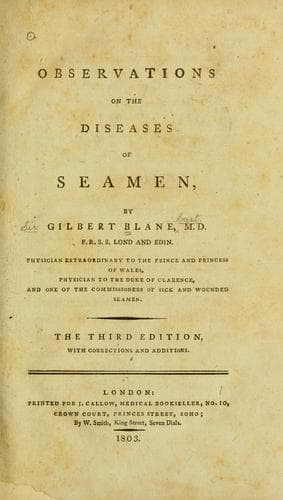
Observations on the Diseases of SeamenBlane, Gilbert, Sir
History
Observations on the Diseases of Seamen
Blane, Gilbert, Sir
Medicine, Naval -- Early Works To 1800; Sailors -- Diseases
There are some passages in ancient history in confirmation of the same
opinion. Herodotus relates, that the ancient Egyptians were the most
healthy of all the nations, except the Libyans, and he imputes this to
the invariableness of their weather, and the serenity of their sky.
But he mentions in another part of his works, that they were also the
most cleanly of all people, not only in their household utensils, but
in their persons, and that their clothing was chiefly of linen, which
it was one of the principal studies of their life to wash and keep
clean--ἑιματα δε λινεα φορεουσι ἀιει νεοπλυτα ὲπιτηδευοντες τουτο
μαλισα. Herodot. Euterp. 37.--It is remarkable that he makes no mention
of the plague, though he gives a very minute account of the country
from his own observation, from whence it may be naturally inferred,
that it did not then exist there, though Egypt is now so subject to it,
that the plague is supposed by many to be an endemial disease in it.
It would appear also from another passage in this historian, that he
uses the word λοιμος, which we translate _plague_ in a loose sense to
signify any violent acute distemper; for he relates that a great part
of the army of Xerxes, in their retreat from Greece, perished by the
_plague_ λοιμου and dysentery, in consequence of famine. Herod. Lib.
viii. cap. 115.
[58] It is proper also to observe here, that those ships which are
built of winter-felled timber are much drier than those built of what
is summer felled; and this circumstance should have been mentioned
with regard to the Montague, for the cause of her healthiness,
notwithstanding her being a new ship, was probably from being built of
winter-felled timber. It should, therefore, be strictly enjoined to
fell the wood in winter; for those who are employed to do it have an
interest in doing it in summer, on account of the value of the bark.
[59] A windsail is a long cylinder of canvass, open at both ends, kept
extended with hoops, and long enough to reach from the lowermost parts
of the ship through all the hatchways into the open air.
[60] It is not necessary that seamen should have chests, for bags or
wallets answer their purpose equally well, and are much more convenient
in respect of stowage.
[61] Since the first edition of this work, I have met with a fact in
confirmation of this principle, with regard to the cutaneous complaint
called the _ring-worm_. This had prevailed in a private school in the
neighbourhood of London, which I visited, but it had to all appearance
become extinct; yet it nevertheless affected those boys who were newly
sent to the school.
[62] It is mentioned by Thucydides, that while the plague raged at
Athens, the people were affected with no other disease; from which it
would appear that those persons who would otherwise have been attacked
with some particular indisposition, were seized with the plague in
place of it. Vide note p. 247.
[63] Part I. Book II. Chap. VI.
Public-domain text, read in full here on John Shaqi.
Reviews
Reviews
No reviews yet
Be the first to share your thoughts on this work.
Elsewhere in the archive
Join the Discussion
Join the discussion
Sign in to leave a comment or review.
Sign InorCreate an account