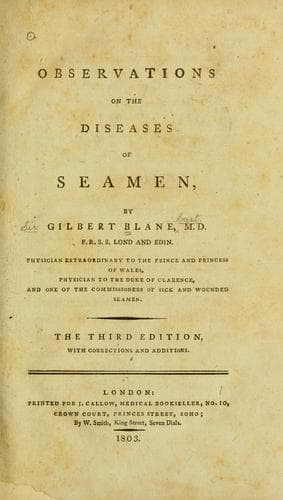
Observations on the Diseases of SeamenBlane, Gilbert, Sir
History
Observations on the Diseases of Seamen
Blane, Gilbert, Sir
Medicine, Naval -- Early Works To 1800; Sailors -- Diseases
[92] The form of administering this medicine was to add twenty drops of
thebaic tincture, from half a grain to a grain of emetic tartar, and
from five to ten grains of nitre, to two ounces of water or camphorated
julep, of which one half was given about two hours before the common
hour of rest, and the remainder at that hour. If spiritus Mindereri is
preferred to the nitre, it may be given from two drachms to half an
ounce for a dose, and it is better to administer it separately; for if
it should not be exactly neutralized, it may decompose the antimonial,
and render it inactive.
[93] Since the publication of the first edition of this work, there has
appeared a small tract on the treatment of low fevers, by Dr. Wall,
of Oxford, and as his ingenuity and learning give him a just claim to
the high rank he holds in his profession, attention is due to what he
advances. The principal scope of the work is to recommend, from his own
observation, the early use of opiates in those fevers, and the Doctor’s
authority, as well as my own experience, convince me of the propriety
of this practice in many cases occurring in this country, particularly
among the lower sort of people, for whom spare diet and hard labour
render evacuations less necessary than among the better sort. The
inferior class of people are also more subject to this sort of fever
from their houses and persons being less clean, and their apartments
being worse ventilated; so that practice in these, as well as other
cases, is to be varied according to the constitution and previous
habits of life.
[94] I first learned this, as well as many other useful and practical
facts, from Mr. Farquhar, Surgeon in London, who has laid me under the
greatest obligations by communicating many of his observations, derived
from the most extensive experience and a truly penetrating sagacity.
[95] I owe this piece of instruction, as well as many others, to Dr.
Cullen’s Lectures.
[96] In a review of Haslar hospital made in person by that excellent
officer, Vice-admiral Barrington, in 1780, it was very judiciously
proposed, among other salutary improvements, that there should be two
apartments for the reception of the sick upon their first landing; one
wherein they should be stripped of their dirty clothes, and another in
which they should go into the warm bath, and put on the hospital dress,
that they might not carry infection into the wards.
[97] The following is the form of it, and it was first introduced by
Mr. Whitfield, apothecary to the hospital, under the name of Bolus
Sedativus:--℞. Confection. Damorat. [dram]ss. Castor. Russic. pulv.
[scruple]ss. Tinct. Thebaic. g^{tt.} iv. Syr. sim. q.s. Fiat bolus
sexta quaque hora sumendus.
Public-domain text, read in full here on John Shaqi.
Reviews
Reviews
No reviews yet
Be the first to share your thoughts on this work.
Elsewhere in the archive
Join the Discussion
Join the discussion
Sign in to leave a comment or review.
Sign InorCreate an account