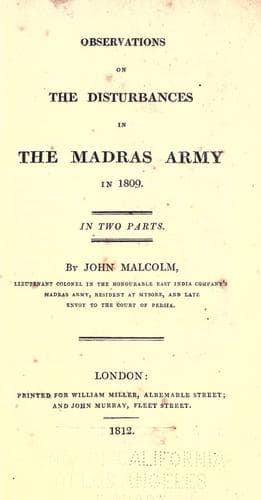
Observations on the Disturbances in the Madras Army in 1809Malcolm, John
History
Observations on the Disturbances in the Madras Army in 1809
Malcolm, John
India. Army -- History; Malcolm, John, 1769-1833
I have received your kind letter of the 8th instant; but fear your
hopes of my success will be disappointed. The voice of passion is alone
heard; and every man that speaks with temper and reason is condemned
and calumniated.
The crisis, in fact, if not arrived, appears now near at hand, when
every officer in the Company's service must determine whether he will
maintain his allegiance to the Government he serves, to his King
and Country, or decidedly throw it off; and assuredly there is no
individual who claims a title to any spirit of independence, who will
not exercise his judgment upon a question which must so deeply involve
all his future prospects and happiness.
If ever there was a moment in which it was important for men to look
at those consequences which are likely to ensue from one step more in
their course, it is the present; and it is assuredly worth while to
pause for a moment, and examine coolly the nature of our grievances,
and the length we are justified in going to obtain redress of them, and
the probable consequences to ourselves and to our country of throwing
off our allegiance to the state.
There were accounts by the last dispatches that the existence of
grievances in this army was already a topic of public discussion.
General McDowall and Colonel Capper have no doubt arrived before this
in England, and they would be soon followed by Colonel St. Leger,
and the other suspended officers. Is it not evident, that, with all
the aggrieved parties in England, the public records which must be
transmitted there, and the voluminous private correspondence which
every ship, since those transactions took place, has carried home,
that every one of the topics of complaint will be a subject of warm
discussion; and will not the agitation they have created in the army
be brought fully forward? And have we not reason to conclude, from
all these circumstances, that an early settlement of these questions
will be made by those authorities, by whom they must at all events
be ultimately judged, unless this country should permanently throw
off its allegiance and obedience to England? As far as we can judge
from the past, there appears reason to anticipate a fair and liberal
decision from the controlling authorities at home, who have certainly
hitherto judged questions of this nature with great attention to both
the feelings and the interests of the Indian army. With this prospect,
can we be justified in resorting to such desperate extremes, because we
are discontented with the acts of a temporary local Government, and not
only involving ourselves in ruin, but injuring, in the deepest manner,
our country, at a moment when it is the duty of every man, who has a
spark of patriotism in his breast, to support her against the numerous
and powerful enemies by whom she is assailed.
Public-domain text, read in full here on John Shaqi.
Reviews
Reviews
No reviews yet
Be the first to share your thoughts on this work.
Elsewhere in the archive
Join the Discussion
Join the discussion
Sign in to leave a comment or review.
Sign InorCreate an account