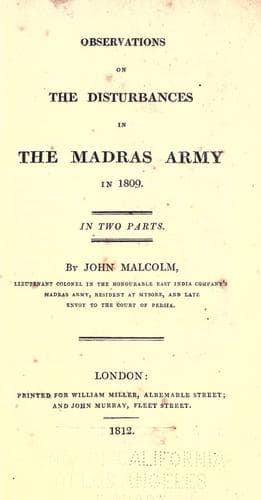
Observations on the Disturbances in the Madras Army in 1809Malcolm, John
History
Observations on the Disturbances in the Madras Army in 1809
Malcolm, John
India. Army -- History; Malcolm, John, 1769-1833
emergency which this garrison had so rashly precipitated. I then read
them a letter to Colonel McLeod[80], pointing out all the horrors of
the crisis to which they were rushing. They appeared forcibly struck
with what I said and read, and expressed their hope that their brother
officers would alter their resolution, and not impede the course of
proceeding which I intended to pursue. It might, they said, afford some
ray of hope of the present distractions being ended; for though they
knew my sentiments differed widely from theirs, and that I was devoted
to my duty to Government, they were also sensible that I had warm
feeling for the situation of my brother officers. I went, immediately
after this interview, to dine at the mess of the regiment, and (strange
inconsistency!) received every mark of respect and kindness from men
who had been debating all the morning whether they should enter into a
contest with me for the authority of the garrison!
_19th July._ I went into the Fort early this morning, and called upon
Colonel Innes to give me a full statement of all that had passed
relative to the origin of those discontents that terminated in the
mutiny of the 25th ultimo[81]. I also called upon Major Storey, Captain
Andrews, and Mr. Nixon, the adjutant of the regiment, to give me every
information they had relative to these transactions. I was waited
upon, soon after I went to the Fort, by two of the senior officers,
who were, they said, desired by all to state that a general confidence
and respect for my character had induced the garrison to change their
resolutions, and that they hoped I would follow the course of inquiry
I intended; and, after making the investigation, proceed, if I thought
it advisable, to Madras. They would, they said, during my absence be
as jealous of my honour as of their own, and promise not to depart in
the slightest degree from the path of duty and order, unless a rise in
other stations was to take place; of which, they said, they thought
there was no probability, particularly as they would write to inform
them of the pledge they had made, and entreat them not to make any call
upon them before my return to my command. I told them I felt obliged by
this mark of their regard and confidence; but I would not receive it,
if I thought it was made under any idea or expectation that I would be
the advocate of their cause, or that of the army. They disclaimed any
such idea. I would, they knew, from what they had seen, do my duty in
the manner I thought best. I was gratified with the pledge I received;
which, as M. H. afterwards privately observed, gave me a stronger tie
on the officers while I was absent than I could have had during the
same period, if present. The reasons which led me to resolve on going
to Madras were fully stated to Sir George Barlow in a letter under this
date.
Public-domain text, read in full here on John Shaqi.
Reviews
Reviews
No reviews yet
Be the first to share your thoughts on this work.
Elsewhere in the archive
Join the Discussion
Join the discussion
Sign in to leave a comment or review.
Sign InorCreate an account