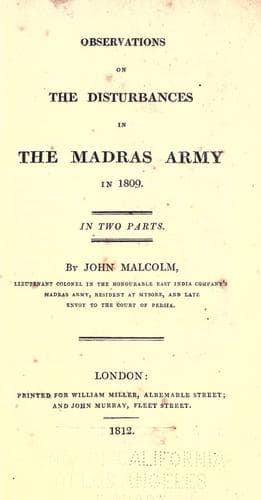
Observations on the Disturbances in the Madras Army in 1809Malcolm, John
History
Observations on the Disturbances in the Madras Army in 1809
Malcolm, John
India. Army -- History; Malcolm, John, 1769-1833
Par. 7. "When I transmitted Lieutenant D. Forbes's application to
head-quarters for a general court martial, it was accompanied by
my official letter, and report of the circumstances which occurred
on the evening of the 24th May last, at the mess-room of the M. E.
regiment, and which is now subjoined for your information; as also the
correspondence which subsequently passed between me and the officers of
the Madras European regiment upon this interesting subject, now under
consideration; which I felt it my duty to forward to head-quarters for
the consideration of the Commander-in-Chief, for the reasons assigned
in my two notes addressed to Lieutenant and Adjutant Nixon. It only
therefore remains for me to add, that what I honestly, candidly, and
conscientiously stated to have taken place at the mess of the M. E.
regiment on the evening of the 7th of May last, was the substance of
what actually passed, and, to the best of my recollection, in nearly
the same words, (or words to the same effect,) as I most solemnly
declare upon my honour, and am ready to confirm upon oath.
(Signed) "J. INNES, Lieut.-Col."
"Masulipatam,
19th July, 1809."
Previous to entering upon the documents alluded to, I will call your
attention to the two following paragraphs of the Governor General's
letter, addressed to Sir G. H. Barlow, Bart. K. B. Governor of Fort
St. George, dated 27th May, 1809; by which you will observe, I was
not only _sanctioned_, but _expected_ to give every information to the
Commander-in-Chief and Government, (from my official situation,) which
could tend to check disaffection in this division, and promote the
public service either by my own example and exertions, or by applying
to a higher authority to suppress it.
Par. 89. "We concur also entirely in the sentiment expressed in your
general orders of the 1st ultimo, that it is not sufficient for
officers holding commands to avoid a participation in such proceedings,
but that it is their positive and indispensable duty to adopt the
most decided measures for their suppression, and to report them to
the superior authorities. The purposes of tumult and sedition may as
effectually be promoted by their negative concurrence as by their
active participation.
Par. 90. "The neglect of duty is an offence varying only in degree
from a positive violation of it; and any officer who, apprised of the
progress of disorderly proceedings among those who are placed under his
immediate control, abstains from any attempt to suppress them either
by the exertion of his own authority or by an appeal to the superior
power, gives to those proceedings one mode of encouragement, and cannot
stand absolved of blame, nor found a claim to immunity, nevertheless to
a continuance of that implicit confidence which is attached to stations
of authority, on the basis of so culpable and mischievous a neutrality."
(A true copy.)
(Signed) "J. INNES, Lieut.-Col."
Public-domain text, read in full here on John Shaqi.
Reviews
Reviews
No reviews yet
Be the first to share your thoughts on this work.
Elsewhere in the archive
Join the Discussion
Join the discussion
Sign in to leave a comment or review.
Sign InorCreate an account